BACnet Gateway
Overview
The BACnet Gateway extension enables seamless integration between LoRaWAN® end devices and BACnet/IP systems.
It provides bidirectional data exchange, device monitoring, and control capabilities for building automation, smart facilities, and industrial environments.
This extension allows LoRaWAN devices to be represented as BACnet objects, making it easy to integrate wireless sensors into existing building management systems (BMS).
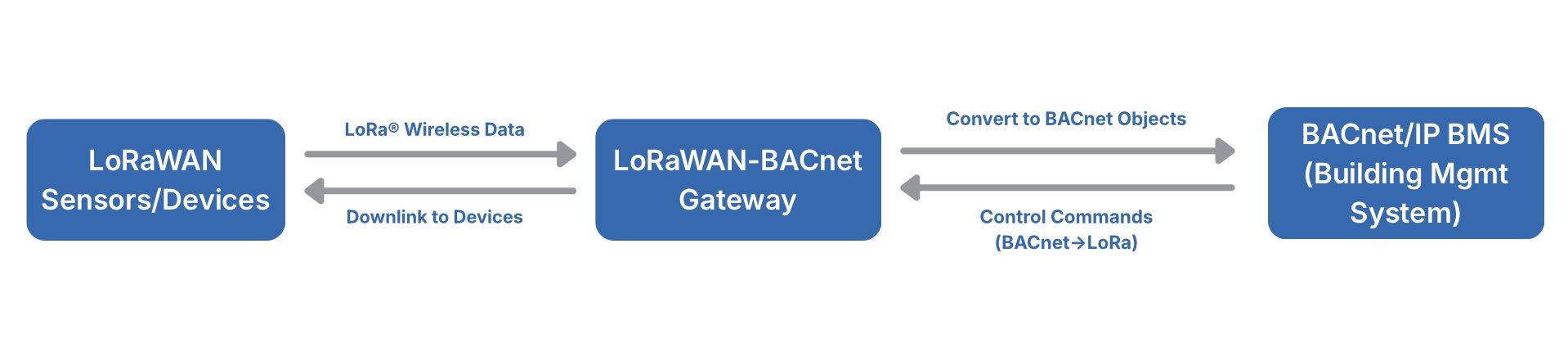 Figure 1: LoRaWAN–BACnet Bidirectional Data Flow
Key Features
- LoRaWAN®–BACnet/IP bridging: Convert LoRaWAN device data into standard BACnet objects.
- Bidirectional control: Support LoRaWAN uplink telemetry and BACnet-to-LoRaWAN control commands.
- Easy Web UI configuration: Simple and intuitive setup for mapping and BACnet parameters.
- MQTT Integration Support: Allows flexible data forwarding or additional application-layer integrations through MQTT brokers.
- Broad BMS compatibility: Compatible with Carrier BMS and standard BACnet/IP systems.
Technical Capabilities
The BACnet Gateway provides the following capabilities:
- BACnet/IP Standard: Based on BACnet/IP (ANSI/ASHRAE 135-2016)
- Communication: UDP-based BACnet/IP service bound to the active WAN interface
- Network Interfaces: Ethernet (PoE+), Cellular, Wi-Fi
- Device Identity: Configurable BACnet Device Name and Instance ID
- Supported Object Types: AI, AO, AV, BI, BO, BV, and OctetStringValue
- Supported Services: ReadProperty, WriteProperty, SubscribeCOV, and Confirmed/UnconfirmedCOVNotification
Typical Application Scenarios
- HVAC Monitoring and Control: Monitor and control temperature, humidity, differential pressure, and fan-coil systems.
- Energy Metering and Analytics: Measure and analyze electricity, water, and gas usage.
- IAQ and Occupancy-Based Ventilation: Monitor CO₂, TVOC, PM2.5/PM10 for indoor air quality and ventilation.
- Cold Chain and Asset Tracking: Track assets in buildings and warehouses for cold chain management
Configure BACnet Gateway
Configure the BACnet Gateway on the RAK7437/RAK7437C to integrate LoRaWAN devices with BACnet/IP-based building automation systems.
Prerequisites
- The RAK gateway must operate in Built-in Network Server mode.
- Your LoRaWAN end devices and the gateway must use the same regional frequency band.
Access the Extension
-
Open your browser and log in to the gateway's web UI. If necessary, refer to the Quick Start Guide section of the gateway’s user manual.
-
Once logged in, navigate to Extensions in the left menu.
NOTEClick the WisGate logo to expand the left menu and view all available tabs.
-
Under the Installed tab, you will see the BACnet Gateway extension. Click Launch.
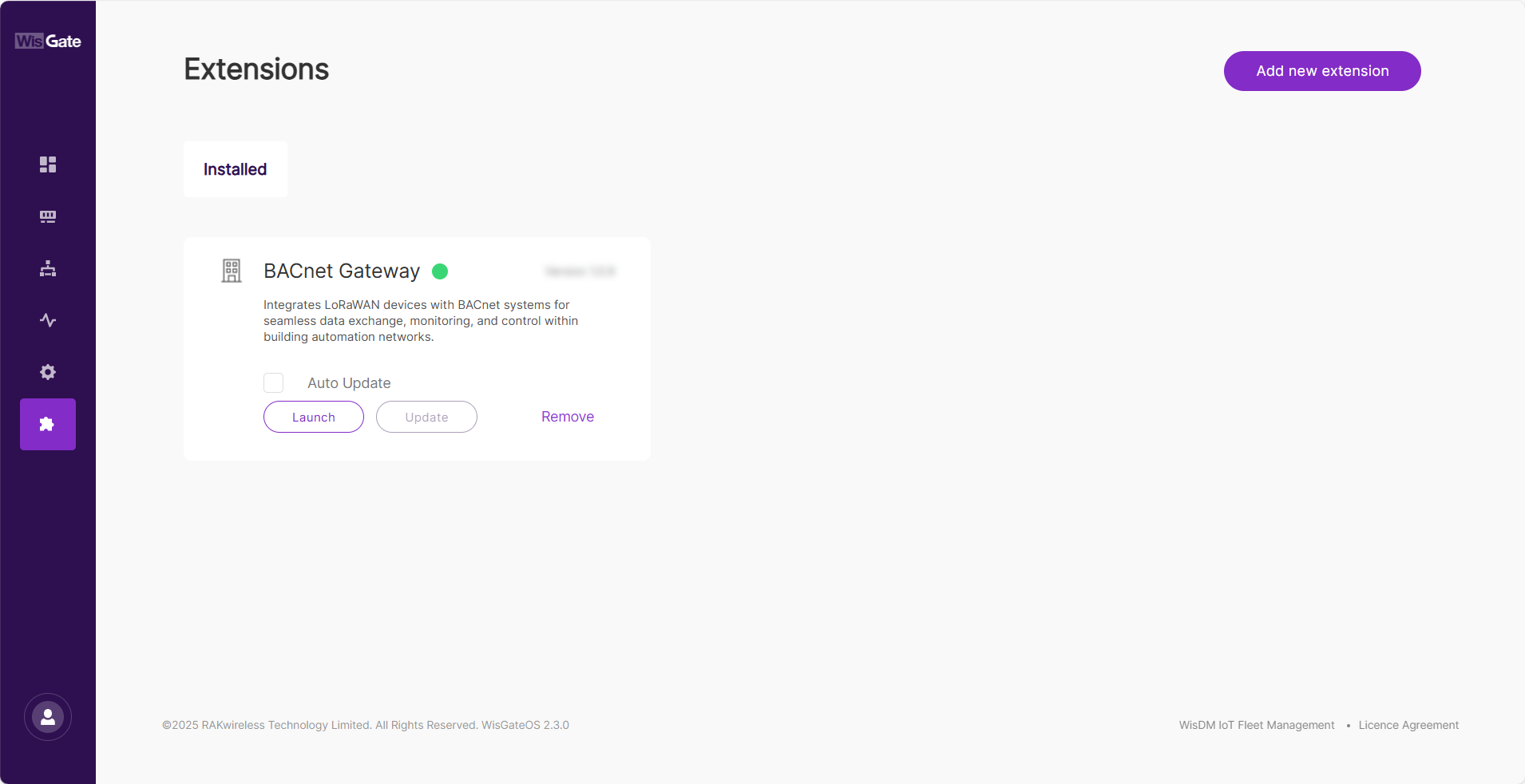 Figure 1: Extensions Tab
BACnet Configuration
This section enables you to configure the basic settings for the BACnet Gateway.
- In the Configuration tab, set up the basic information for the BACnet Gateway, including the following:
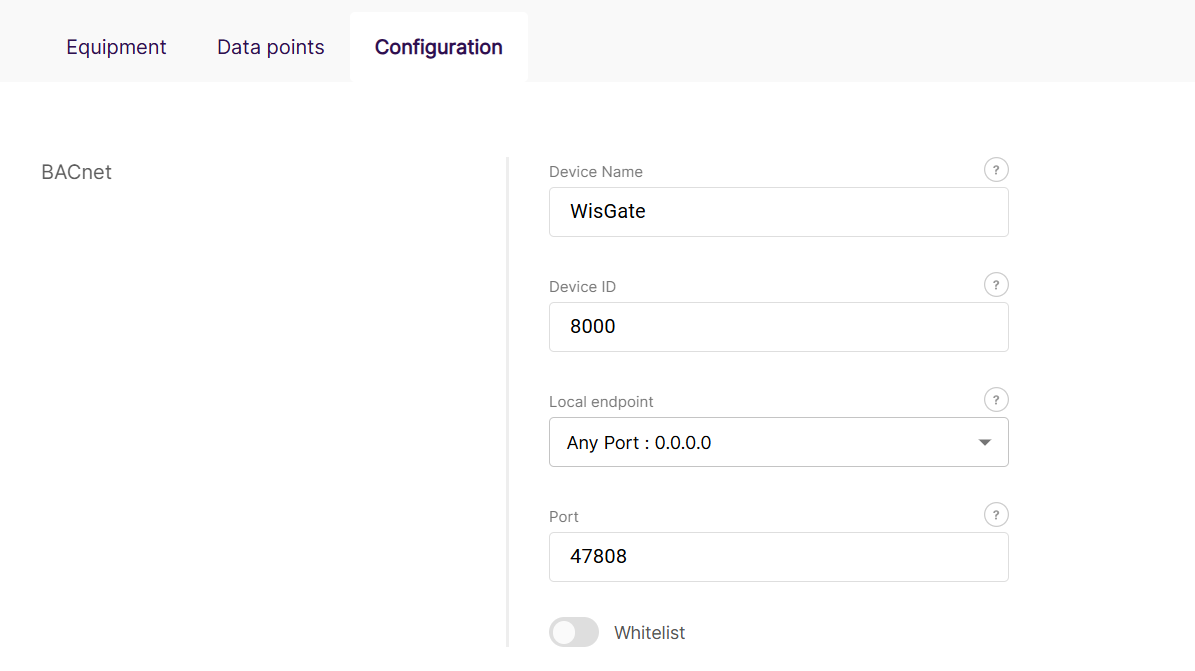 Figure 1: BACnet Configuration
-
Device Name: The name of the gateway as it will appear in the BACnet network.
-
Device ID: A unique Device Instance for the BACnet network. The ID range is 1 to 4194303.
-
Local Endpoint: Specifies the IP interface that the BACnet Gateway uses for UDP communication.
NOTEYou can either select a specific network interface to bind the BACnet Gateway to a particular IP address assigned by the connected network or choose Any Port: 0.0.0.0 for automatic IP selection.
If you select Any Port: 0.0.0.0, the BACnet Gateway will dynamically select the IP address of the network interface with the highest priority based on the available connections.
-
Port : The UDP port for the BACnet Gateway, ranges from 2000 to 65535, with the default set to 47808 (BAC0).
-
Whitelist : Enables the Whitelist feature, which allows you to specify a list of allowed BACnet Servers (BMS) IP addresses.
-
Source IP address: Specifies the list of IP addresses for BACnet Servers (BMS) that are allowed to communicate with the BACnet Gateway.
- Click Save changes.
Prepare an Equipment Profile
Before adding equipment to the BACnet Gateway, make sure that a matching equipment profile is available for your LoRaWAN device.
An equipment profile defines how the LoRaWAN payload from a device is decoded and mapped to BACnet objects. The BACnet Gateway uses the profile to expose LoRaWAN device data correctly in the BACnet network.
Depending on your device, use one of the following methods to prepare a profile:
- If your device is already supported by a Default profile, no additional action is required. You can proceed directly to Add Your Equipment.
- If your device is not supported by the default profiles, check the RAK BACnet Profile Library and import a matching profile.
- If an existing profile is similar to your device, you can download the profile, customize it, and import it as a Custom profile.
- If no matching or reusable profile is available, submit a new profile request.
Check Existing Profiles
Go to the Profiles tab to view all equipment profiles available on the BACnet Gateway.
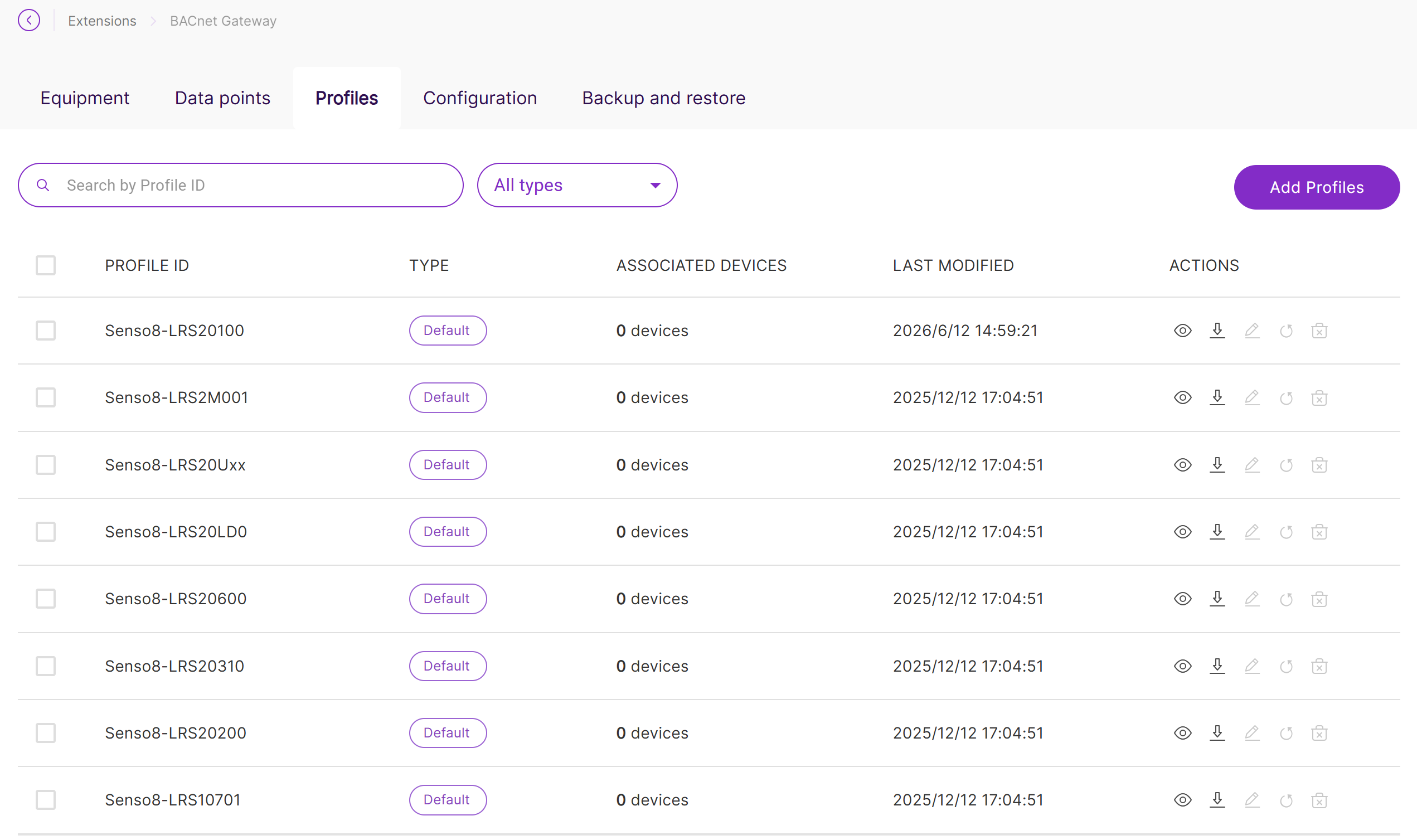 Figure 1: Profiles
Before importing a new profile, check whether a matching profile already exists. You can use the Search by Profile ID field to search for a specific profile, or use the All types drop-down list to filter profiles by type.
The Type column indicates the profile type:
| Type | Description |
|---|---|
| Default | A predefined profile built into the BACnet Gateway. Default profiles cannot be deleted. |
| Custom | A user-imported or user-created profile. Custom profiles can be managed based on the available actions and usage status. |
The profile list also shows the number of Associated Devices and the Last Modified time. This helps you check whether a profile is already in use and when it was last updated.
Use a Default Profile
Default profiles are predefined profiles provided by the BACnet Gateway.
If your device is already supported by a default profile, no additional profile import or configuration is required. You can proceed directly to Add Your Equipment.
To view only default profiles, open the All types drop-down list and select Default.
Import a Profile
If your device is not supported by the default profiles, check the RAK BACnet Profile Library for a matching profile. The library provides additional profiles for different LoRaWAN sensor.
After downloading the matching profile, import it into the BACnet Gateway.
-
Go to the Profiles tab.
-
Click Add Profiles. The Import Profile(s) window appears.
-
Click Choose Files or drag and drop the downloaded profile files into the upload area. Supported file formats include
.bacprof,.yaml, and.yml.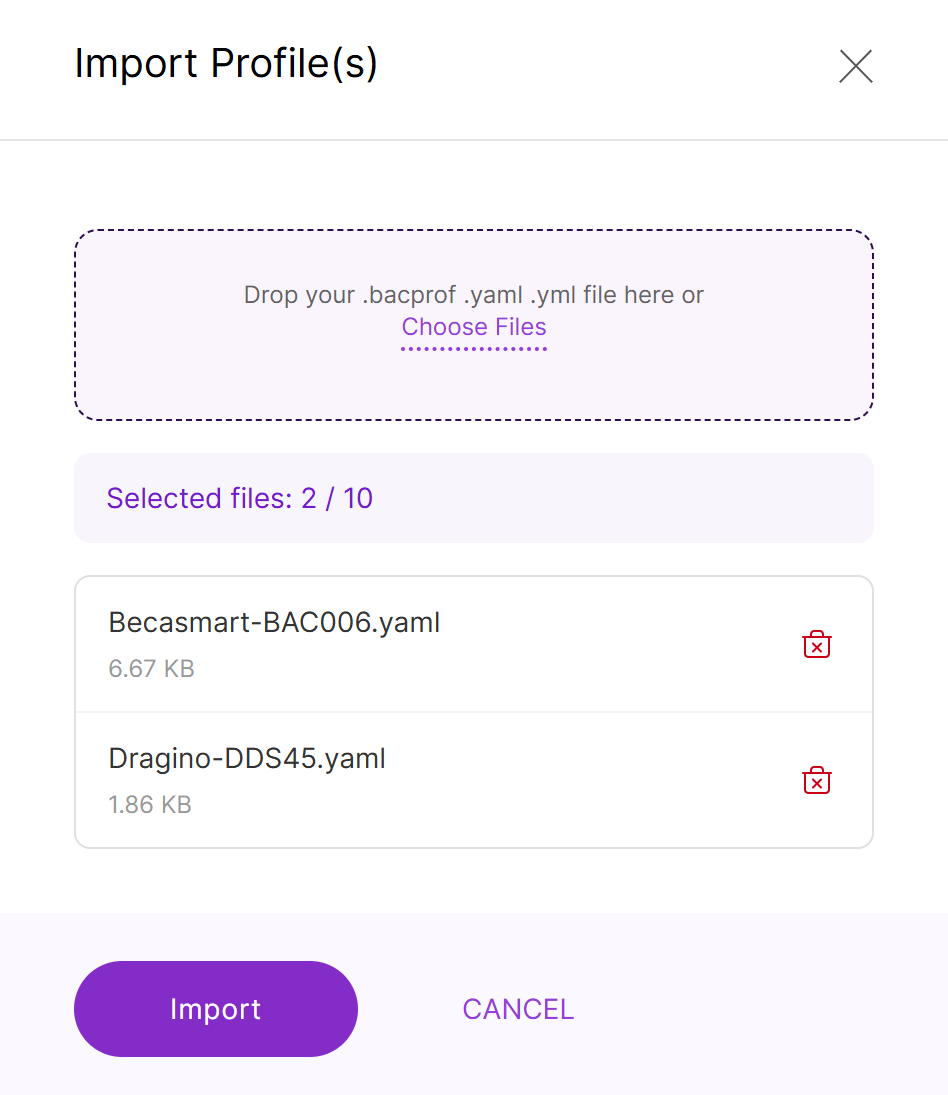 Figure 1: Add downloaded profilesNOTE
- You can import up to 10 profile files at a time.
- To remove a selected file before importing, click the delete icon next to the file.
-
Click Import to upload the selected profile files to the gateway.
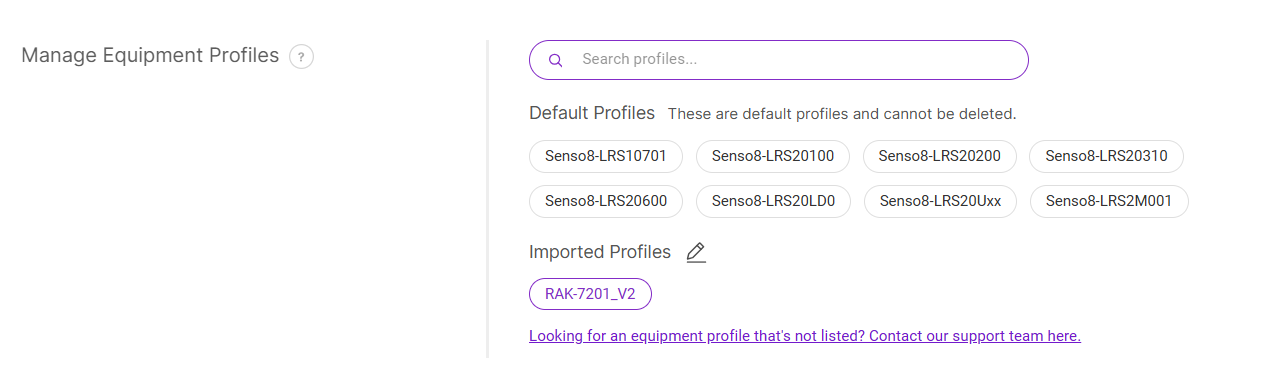 Figure 1: Uploaded Profile
After the profile is imported successfully, it appears in the Profiles tab as a Custom profile and can be selected when you add equipment.
Customize an Existing Profile
You can also use an existing profile as a template and customize it for your own device.
This method is useful when your device is similar to an existing profile, but some payload decoding logic, BACnet object mapping, units, object names, or LoRaWAN parameters need to be adjusted.
- Go to the Profiles tab.
- Find a profile that is similar to your device.
- In the Actions column, click the download icon to download the profile file.
- Edit the downloaded profile file based on your device specifications.
- Import the modified file by following Import a Profile.
After the modified profile is imported, it is displayed as a Custom profile. You can then edit the custom profile online, download it, view its version history, roll back to a previous version, or delete it if it is no longer needed.
Only customize a profile when you understand the device payload format and the required BACnet object mapping. An incorrect profile may cause wrong sensor values, missing BACnet objects, or failed downlink control. For more information about the profile format and customization rules, refer to the RAK7437 BACnet Profiles.
(Optional) Edit a Custom Profile
You can edit a custom profile directly from the Profiles tab.
- Go to the Profiles tab.
- Find the target custom profile.
- In the Actions column, click the edit icon.
- Modify the profile content in the editor.
- Click Save to apply the changes.
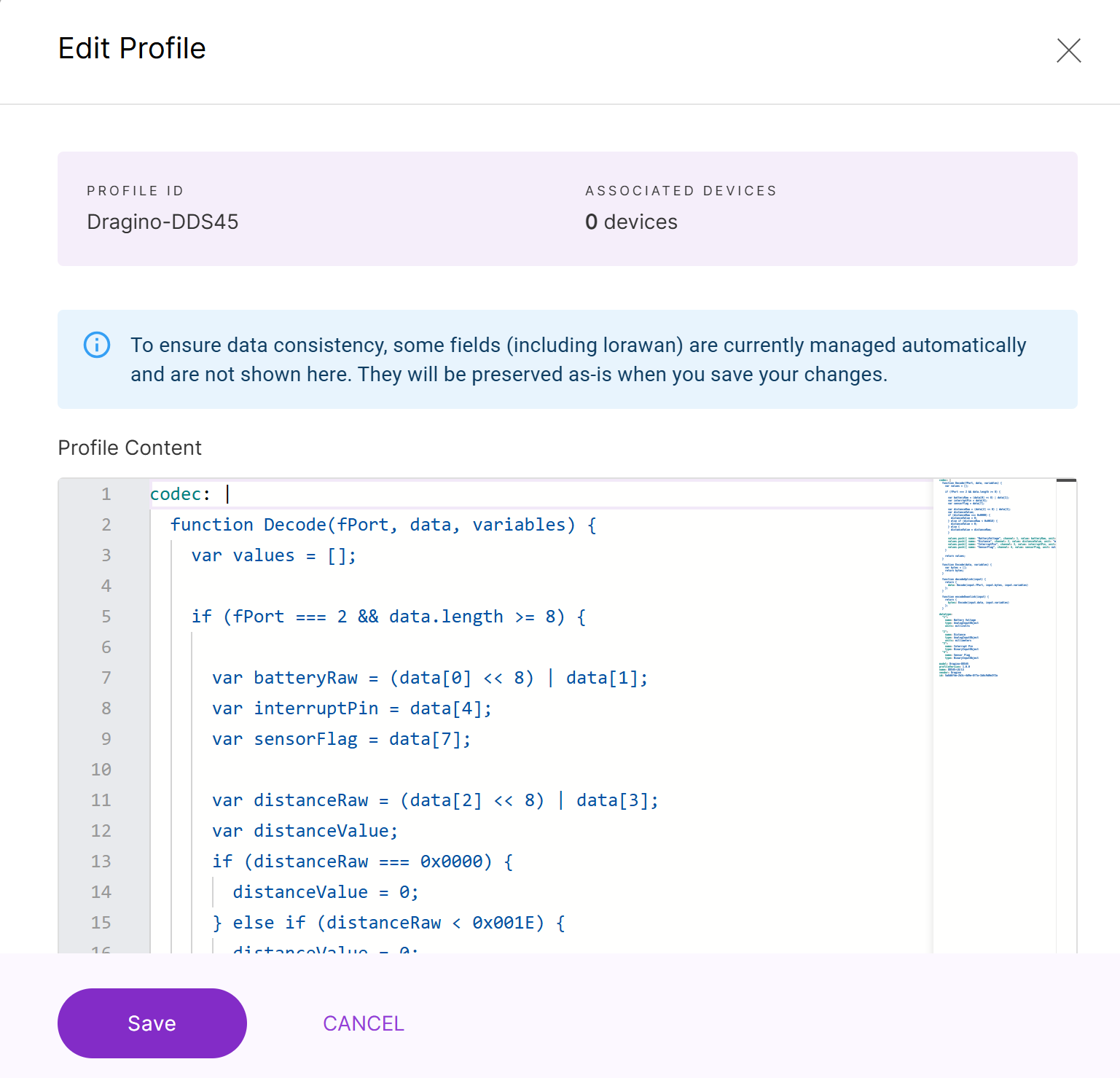 Figure 1: Edit Custom Profile
Editing a custom profile may affect all equipment associated with this profile. Before saving changes, make sure the payload codec, BACnet object mapping, units, object types, and downlink settings are correct.
(Optional) Roll Back Profile Version
When you edit and save a custom profile, the system automatically creates a backup version. You can view the profile version history and roll back to a previous version if needed.
- Go to the Profiles tab.
- Find the target custom profile.
- In the Actions column, click the rollback icon.
- In the Profile Version History window, review the available backup versions.
- Click the view icon to check a backup version, or click the rollback icon to restore a previous version.
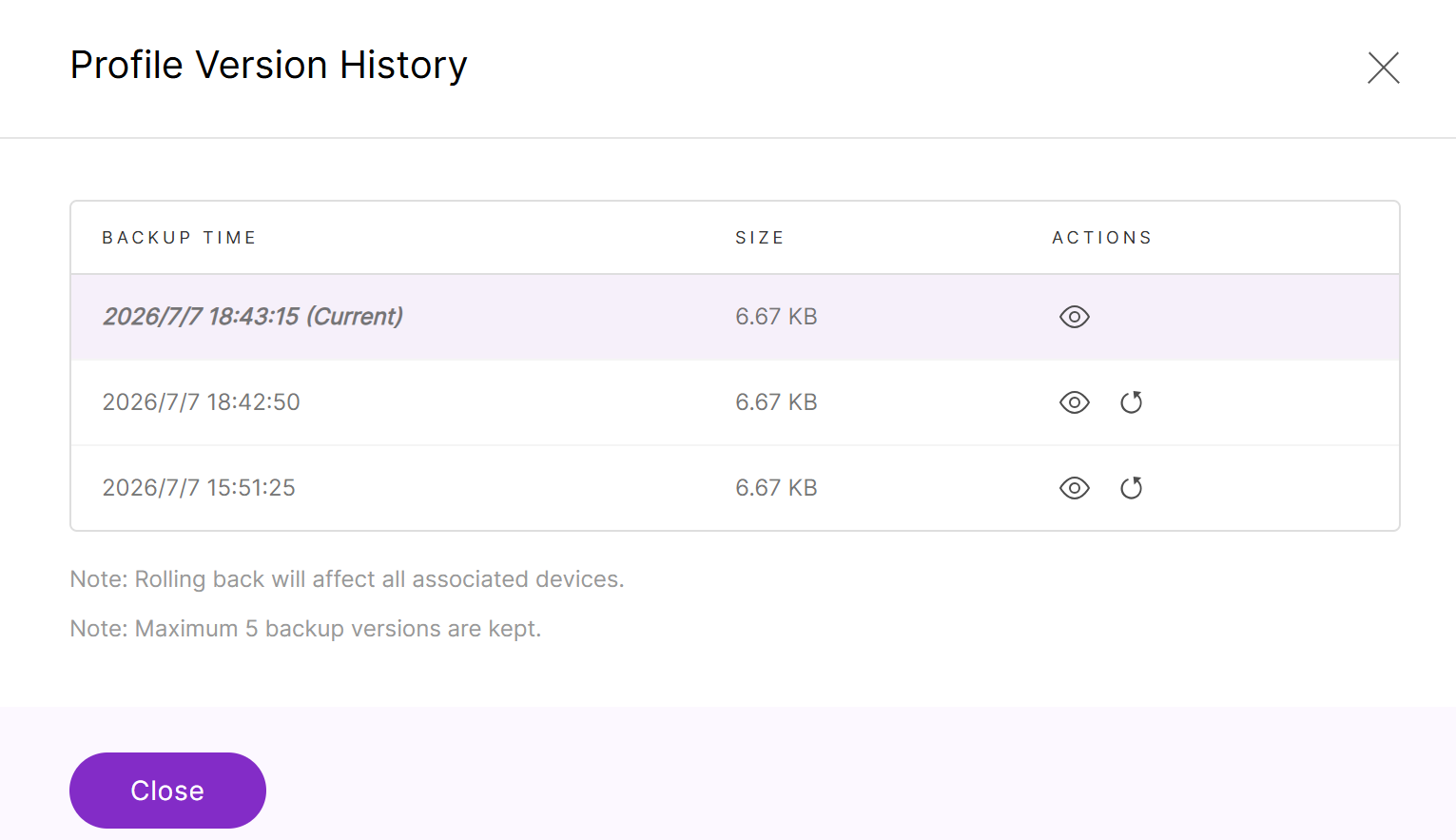 Figure 1: Profile Version History
If the profile has not been edited before, no backup version is available. Backup versions are created automatically after you edit and save the profile.
- A maximum of five backup versions are kept for each custom profile.
- Rolling back a profile affects all equipment associated with this profile. After rollback, review the related data points and verify that the BACnet object mapping is still correct.
Request a New Profile
If no matching profile is available in the default profiles or the RAK BACnet Profile Library, you can request a new device profile for your sensor.
- Visit the RAK BACnet Profile Library.
- Navigate to the Issues tab.
- Click New issue, and select Device Profile Request in the pop-up window.
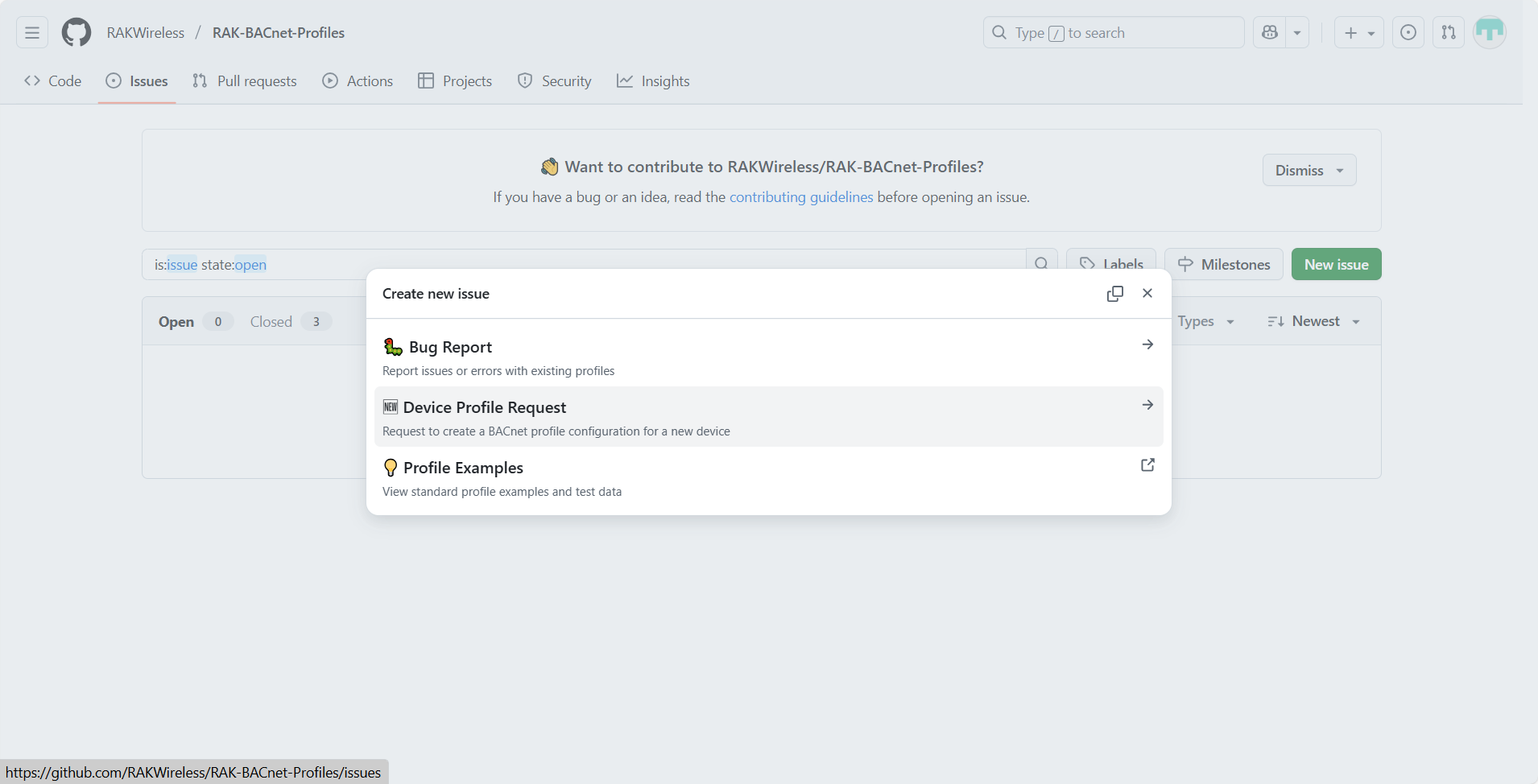 Figure 1: Create a new issue
- Fill out the request form with the required information:
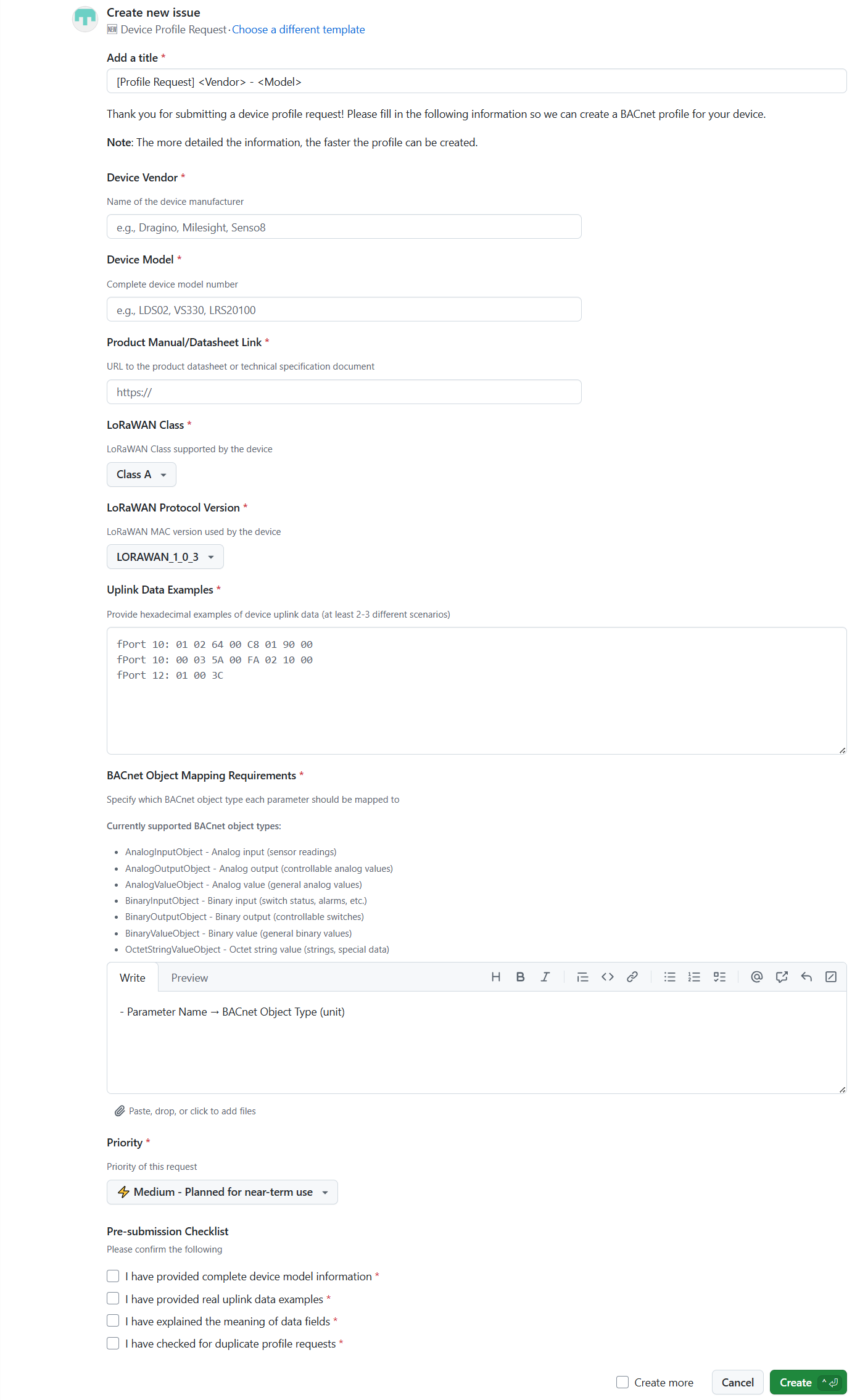 Figure 1: New Device Template Request Form
-
Add a title: Provide a clear and descriptive title using the format
[Profile Request] <Vendor> – <Model>. -
Device Vendor: Name of the device manufacturer.
-
Device Model: Full device model number.
-
Product Manual/Datasheet Link: URL link to the device datasheet or technical specifications.
-
LoRaWAN Class: The LoRaWAN class supported by the device.
-
LoRaWAN Protocol Version: The LoRaWAN MAC version used by the device.
-
Uplink Data Examples: Provide several hexadecimal uplink data samples from your device.
-
BACnet Object Mapping Requirements: Specify how each parameter from the device payload should be mapped to BACnet object types.
Supported BACnet object types include:
- AnalogInputObject - Analog input (sensor readings)
- AnalogOutputObject - Analog output (controllable analog values)
- AnalogValueObject - Analog value (general analog values)
- BinaryInputObject - Binary input (switch status, alarms, etc.)
- BinaryOutputObject - Binary output (controllable switches)
- BinaryValueObject - Binary value (general binary values)
- OctetStringValueObject - Octet string value (strings, special data)
Examples:
Temperature → AnalogInputObject ( ℃)
Humidity → AnalogInputObject (%RH)
EC (Electrical Conductivity) → AnalogInputObject (µS/cm) -
Priority: Select the urgency level for your request.
-
Pre-submission Checklist: Ensure that all checklist items are confirmed before submitting your request.
- After reviewing your information, click Create to submit the request.
RAK technical support will review the details and create a new device profile accordingly. Once the profile is published, download it from the repository and import it into your gateway using Import a Profile.
Add Equipment
Add and configure LoRaWAN end devices (equipment) and associate them with profiles to expose BACnet objects. You can add devices manually or in bulk via CSV, depending on your needs.
Add Device Manually
- In the Equipment tab, click Add Equipment to open the New Equipment page.
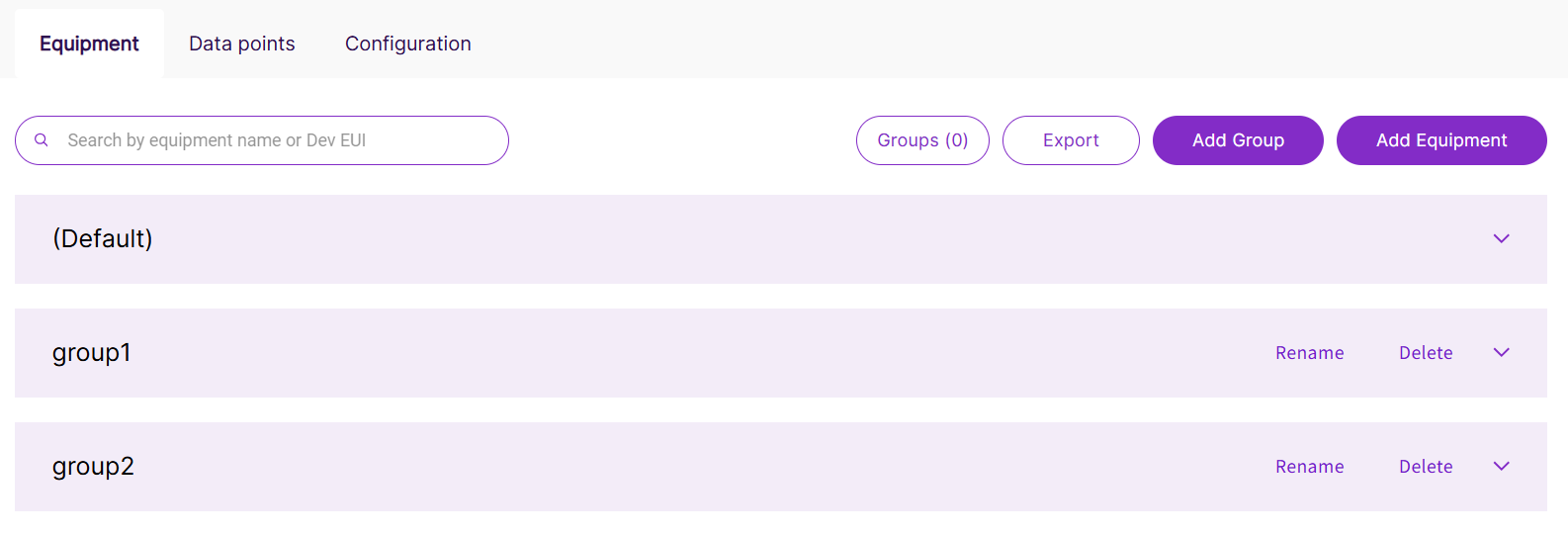 Figure 1: Add Equipment
- In the Manually add a new equipment section, configure the following parameters:
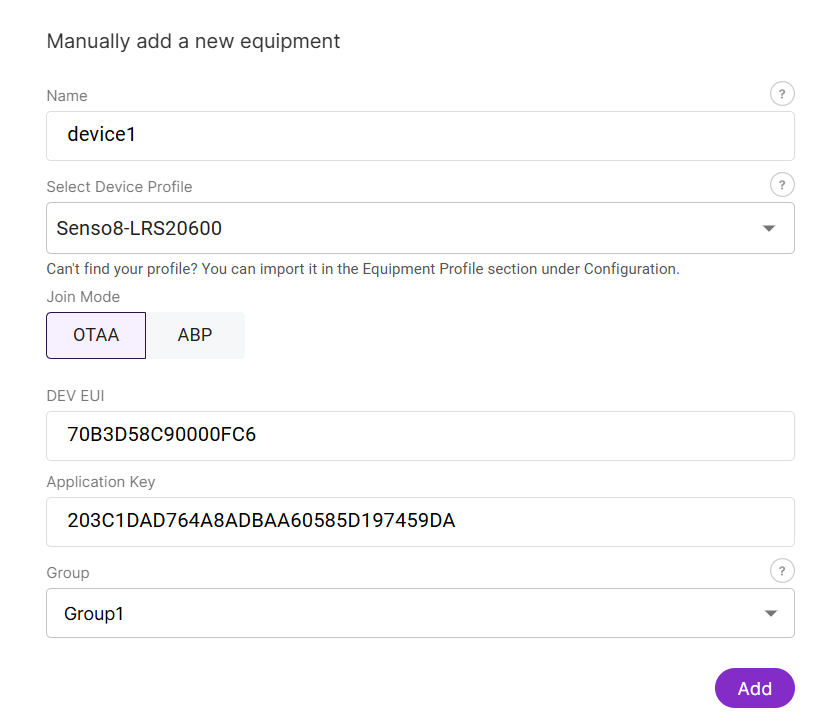 Figure 1: Configure parameters
- Name: Enter the name of the device.
- Select Device Profile: Choose the device profile. If the profile is not listed, ensure you have added the relevant configuration file for your device in the Prepare an Equipment Profile section.
- Join Mode: Select the device join mode (e.g., OTAA).
- DEV EUI: Enter the Device EUI (Unique Identifier).
- Application Key: Enter the AppKey for OTAA.
- Group: Choose Create a new group and provide a name for the group to help organize devices into logical groups.
- Click Add to register the device. Once successfully added, it will appear in the device list.
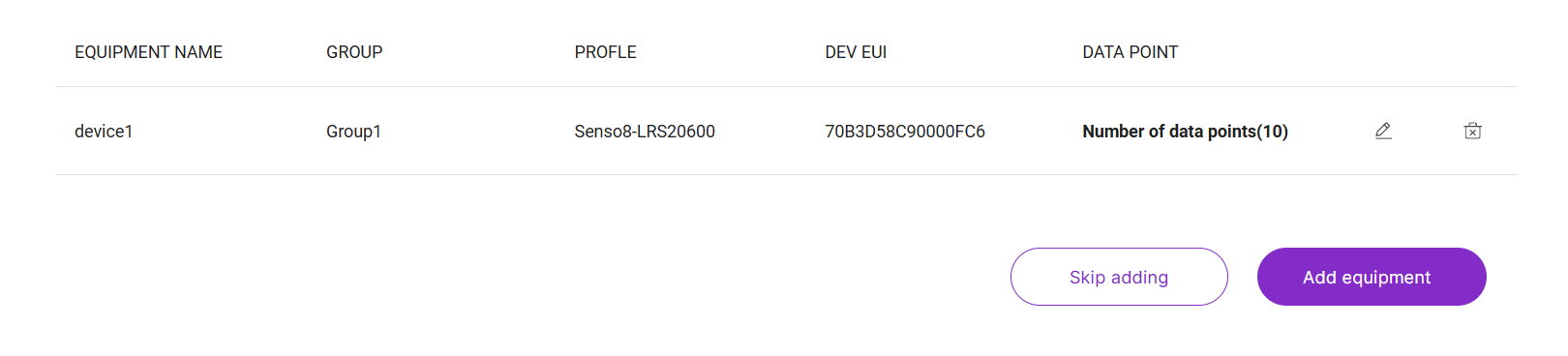 Figure 1: Device List
- (Optional) To customize the data points displayed in the Data Points tab, click the Edit icon in the DATA POINT column.
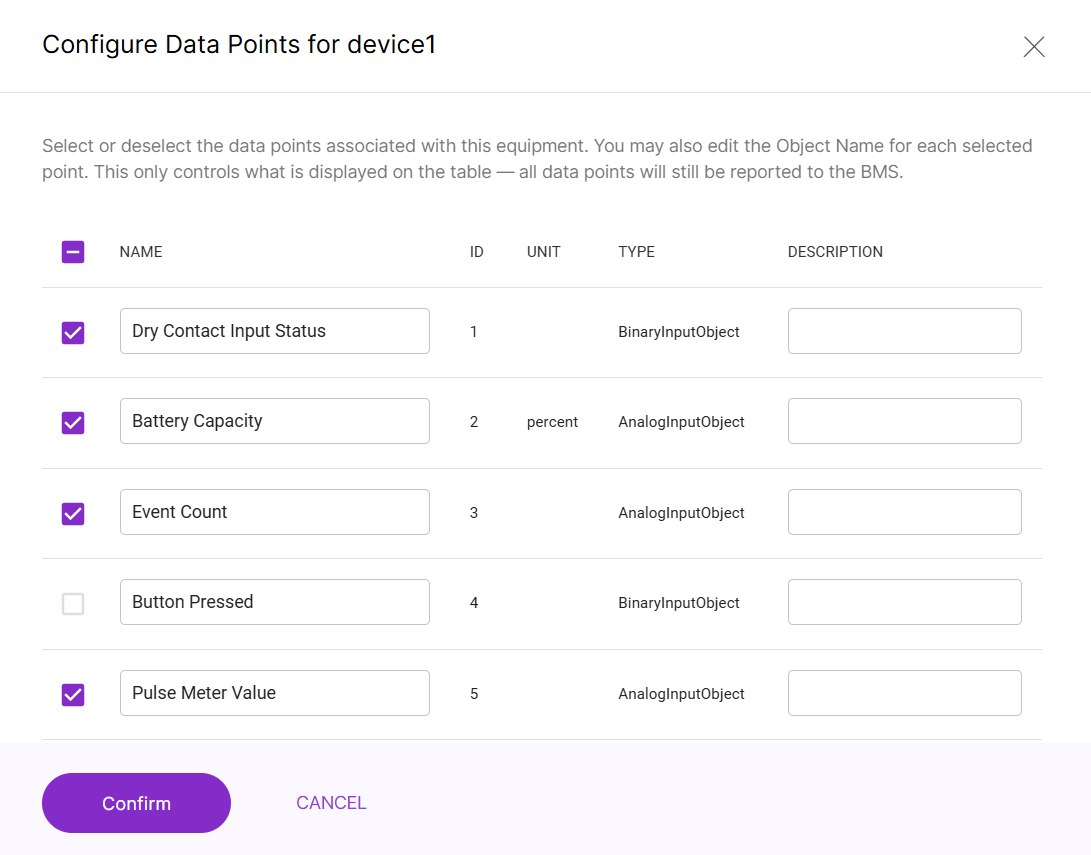 Figure 1: Configure Data Points
- You can select which data points to display in the BACnet Gateway's Data Points tab; however, all data points will still be reported to the integrated BMS.
- You can also customize the object Name and Description of each data point.
- Once finished, click Confirm to apply the changes.
- Click Add equipment to finalize the equipment addition.
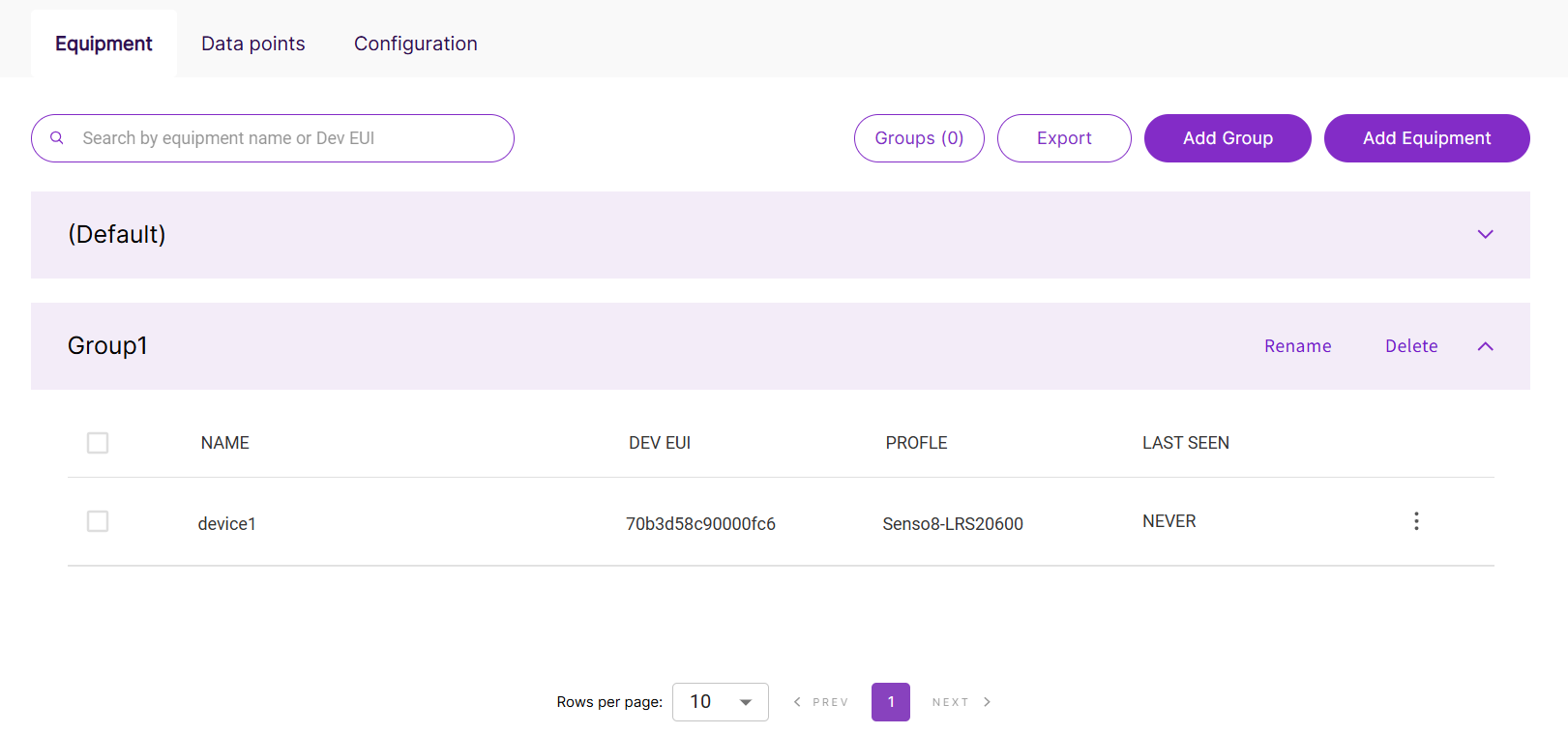 Figure 1: Successfully Added Equipment
Bulk Add Devices (CSV)
Bulk addition of equipment is only available for LoRaWAN® devices that are compatible with the RAKwireless profile database. The equipment list must follow a specific format.
- In the Equipment tab, click Add Equipment to open the New Equipment page.
Figure 1: Add Equipment- In the Upload a list of equipment section, click Download this template to obtain the CSV template.
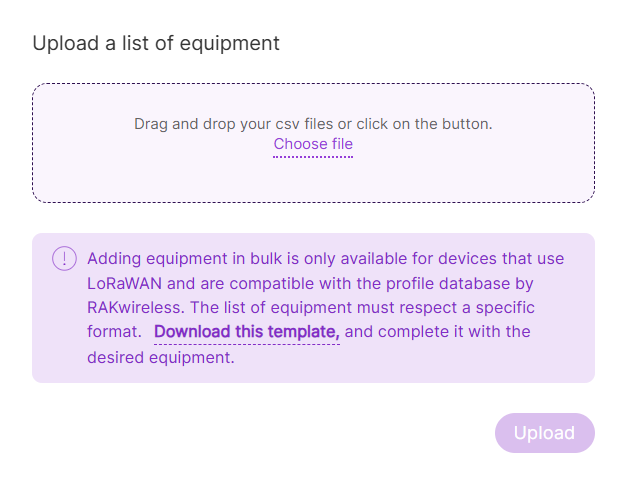 Figure 1: Add Equipment via CSV
- Fill in the device information in the template file:
-
JoinMode
- OTAA (Over-The-Air Activation)
- ABP (Activation By Personalization)
-
Group: Select or create a group to categorize the device, which helps in organizing devices into logical categories.
-
Name: The name assigned to the device.
-
Profile: The device profile that corresponds to the sensor's configuration. For details, refer to Prepare an Equipment Profile section.
-
DevEUI: The unique Device EUI (Extended Unique Identifier) for the device.
-
AppKey: The Application Key used in OTAA for the device to join the network.
-
DevAddr: The Device Address for ABP devices.
-
AppSKey: The Application Session Key used to encrypt and decrypt application payloads for ABP devices.
-
NwkSKey: The Network Session Key used for network-level security in ABP devices.
NOTEEnsure the device profiles are supported and properly formatted. Incorrect or duplicate device information will prevent successful import.
- Click choose file or drag and drop your completed CSV file into the upload box.
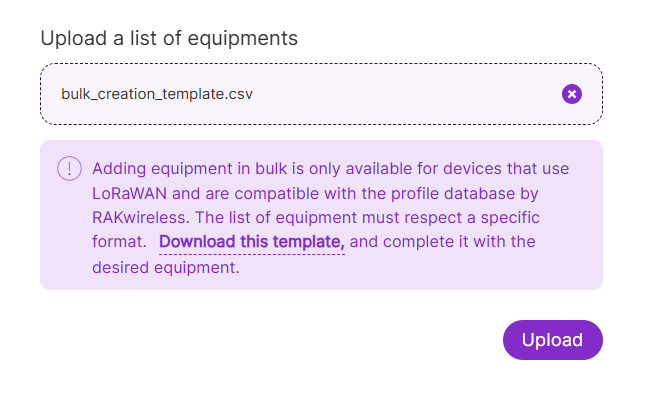 Figure 1: Upload CSV Template
- Click Upload.
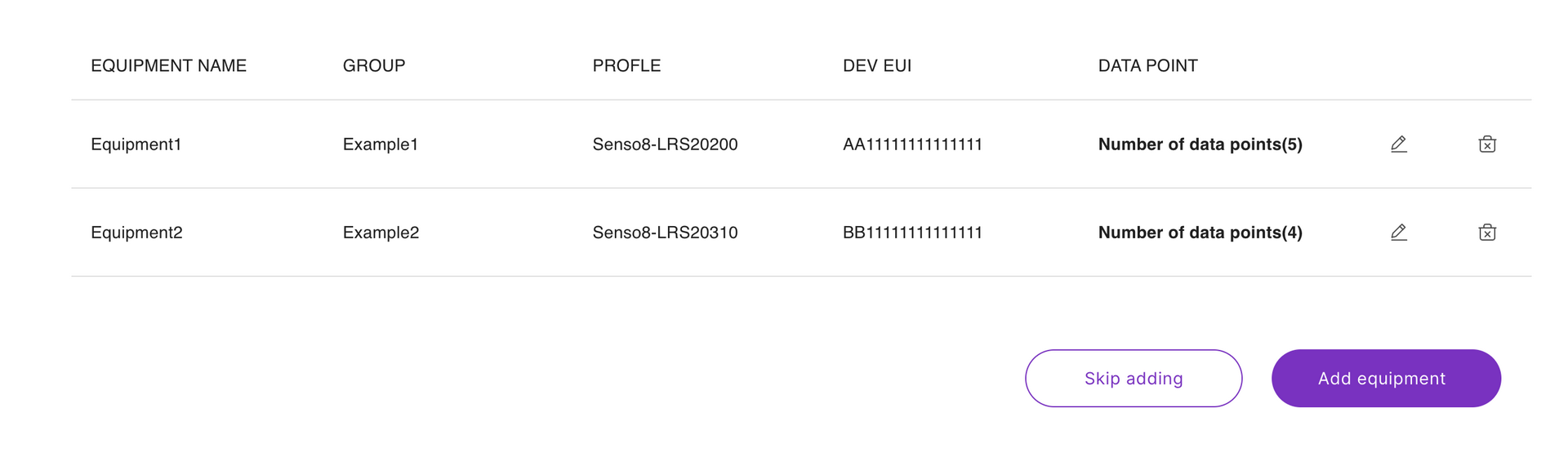 Figure 1: Upload Device Information
- (Optional) To customize the data points displayed in the Data Points tab, click the Edit icon in the DATA POINT column.
Figure 1: Configure Data Points- You can select which data points to display in the BACnet Gateway's Data Points tab; however, all data points will still be reported to the integrated BMS.
- You can customize the object Name and Description of each data point.
- Once finished, click Confirm to apply the changes.
- Click Add equipment to finalize the equipment addition.
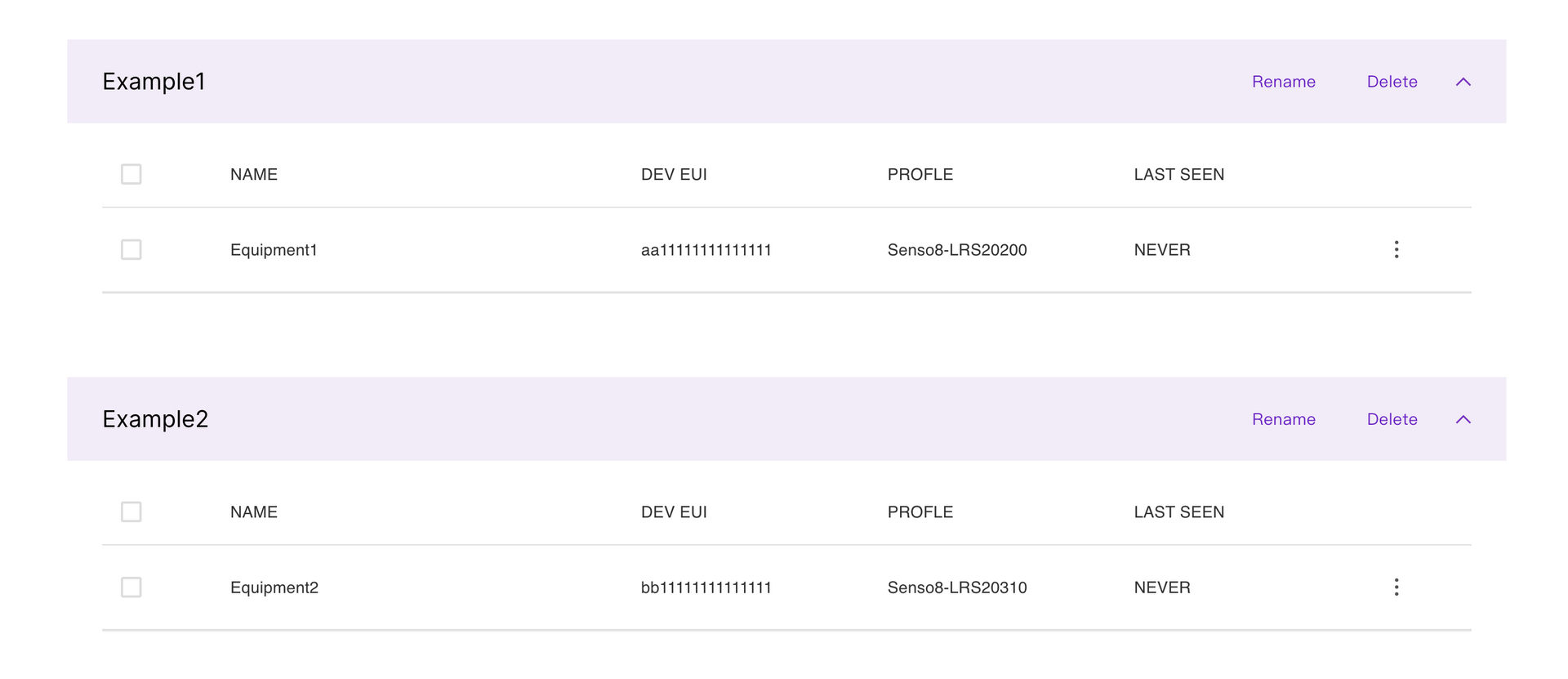 Figure 1: Successfully Added Equipment
Verify Device Join Status
Once the device is registered, you can check its status in the group. If LAST SEEN displays NEVER, it means the device has not yet joined the network.
Next, set your LoRaWAN device join information. Once the device joins, its status will be updated accordingly.
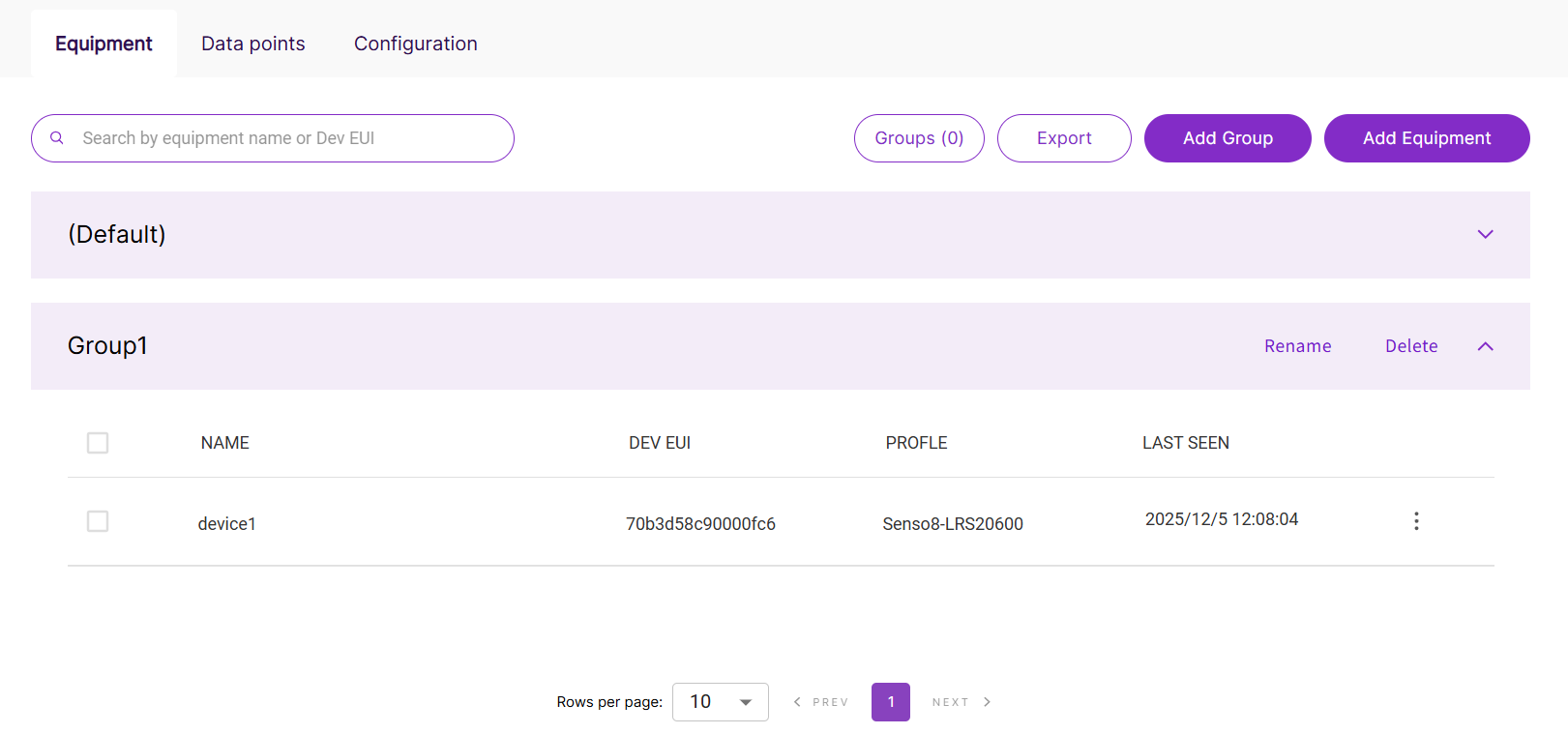 Figure 1: Join Network
View and Export BACnet Data Points
After the BACnet Gateway is configured and your equipment comes online, you can review how LoRaWAN device data is mapped to BACnet objects.
The Data Points page provides a point list generated from the equipment profile. You can use this page to verify the mapped BACnet objects, check the latest values, and export the data point list for Building Management System (BMS) integration.
In a typical workflow, you can:
- Confirm that the equipment is online and has received LoRa uplinks.
- Review the mapped BACnet objects in the Data Points tab.
- Edit the displayed object name or description if needed.
- Export the data point list as a CSV file.
- Use the exported information to configure or verify the points in your BMS.
View Data Points
Go to the Data Points tab to view the data points associated with your registered equipment.
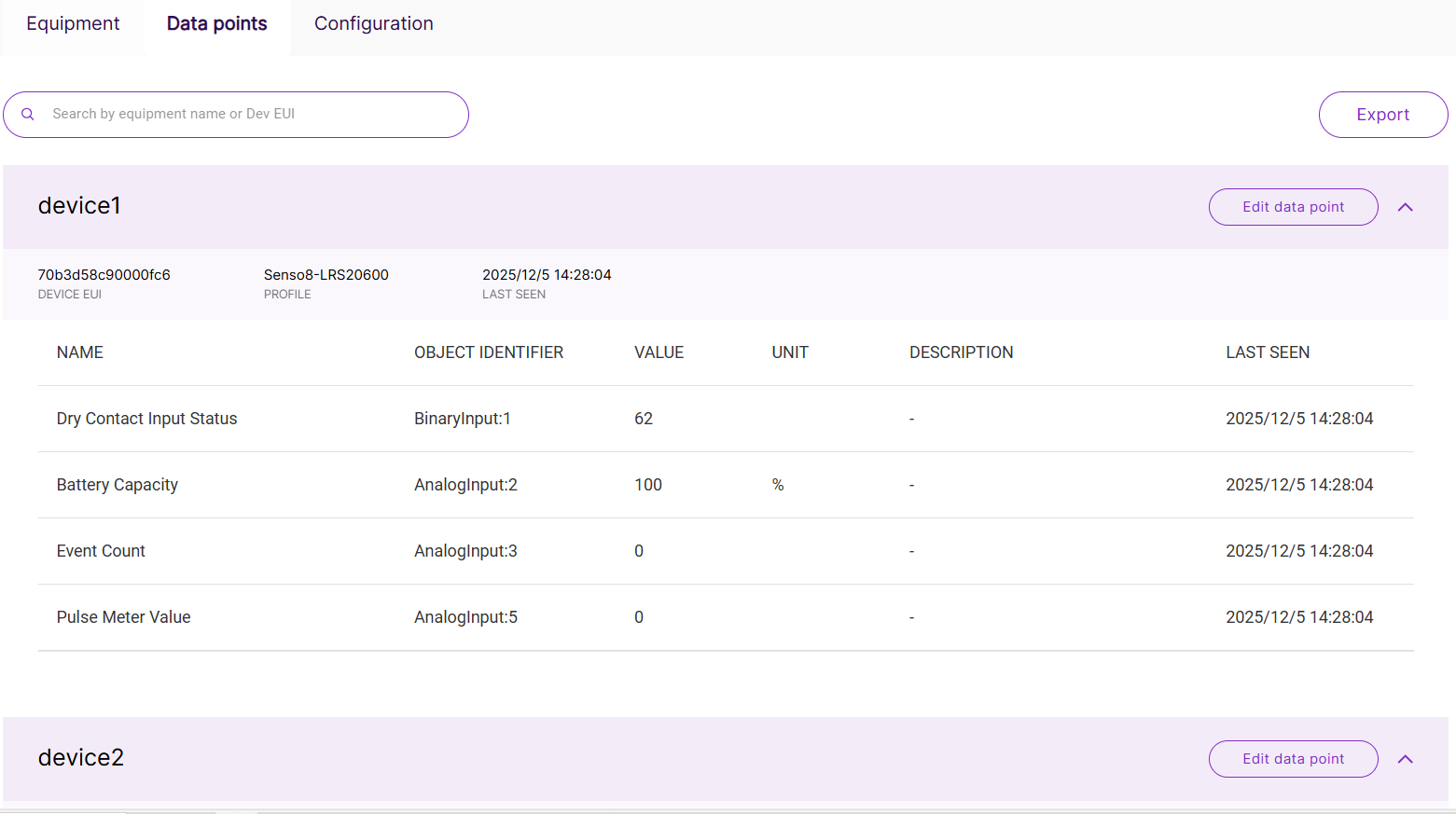 Figure 1: Data Points Overview
Each equipment item is displayed as an expandable section. You can click the arrow icon to expand or collapse the equipment details. You can use the search bar to quickly find equipment by equipment name or Dev EUI.
For each equipment, the page displays the following basic information:
| Item | Description |
|---|---|
| Device EUI | The Dev EUI of the LoRaWAN device associated with the equipment. |
| Profile | The equipment profile used to decode LoRaWAN payloads and map data to BACnet objects. |
| Last Seen | The most recent time uplink data was received. |
After expanding an equipment item, you can view its mapped data points.
| Column | Description |
|---|---|
| Name | The data point name generated from the equipment profile. |
| Object Identifier | The BACnet object identifier, including the object type and object instance, such as AnalogInput:23 or BinaryInput:25. |
| Value | The latest value decoded from the LoRaWAN uplink. |
| Unit | The unit defined in the equipment profile, such as %, ℃, or other BACnet-supported units. |
| Description | Additional description of the data point, if configured. |
If no value is displayed, verify that the equipment has joined successfully, the gateway has received uplink data, and the selected profile contains valid BACnet object mappings.
Edit Data Point
You can customize how data points are displayed in the Data Points tab. Click the Edit data point icon for the target equipment.
Figure 1: Edit Data PointsYou can:
- Select which data points are displayed in the Data Points table.
- Edit the Object Name and Description for each data point.
After making changes, click Confirm to save.
Changing the displayed data points only affects what is shown in the gateway UI. The BACnet Gateway still exposes the data points according to the equipment profile and BACnet object mapping.
Export Data Points
Click Export to generate a CSV file containing the BACnet-mapped data points from your registered equipment.
The exported CSV file can be used as a point list for BMS integration. It helps the BMS engineer identify the BACnet device instance, object type, object instance, object name, and description for each mapped data point.
The exported CSV includes the data points displayed in the gateway UI. If you have customized the displayed data points, confirm the selection before exporting.
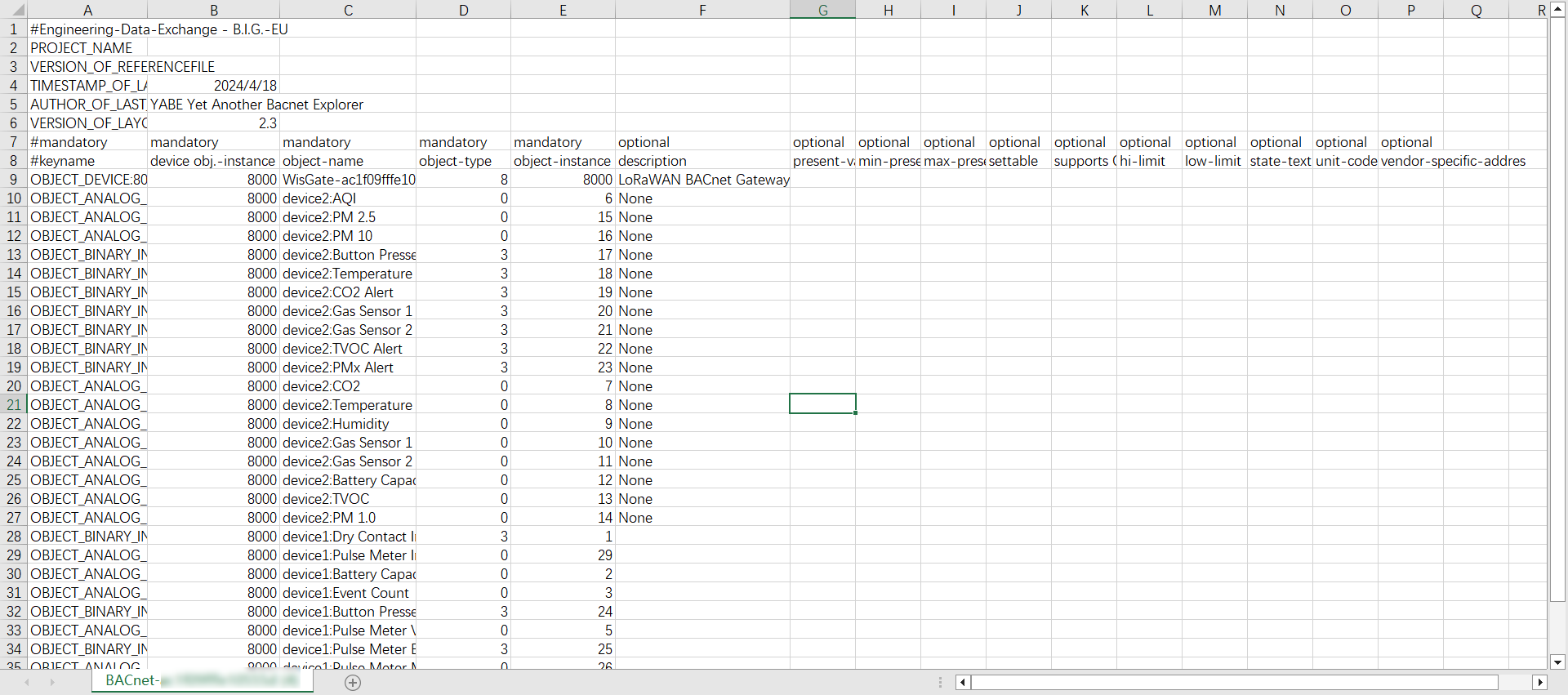 Figure 1: Data Points CSV Structure
CSV Field Descriptions
| Field Name | Description |
|---|---|
| keyname | The unique key that identifies each BACnet object. It follows the format OBJECT_<Object Type>:<Instance ID>. |
| device obj.-instance | The BACnet device instance ID of the gateway. The BMS uses this ID to identify the BACnet Gateway in the BACnet network. |
| object-name | The BACnet object name. It is usually generated from the equipment name and the mapped object name. |
| object-type | The BACnet object type, such as AnalogInputObject, BinaryInputObject, AnalogOutputObject, or BinaryOutputObject. |
| object-instance | The BACnet object instance ID. The combination of object type and object instance uniquely identifies a BACnet object. |
| description | Optional description that provides additional context for the data point. |
Use the Exported Data in BMS
After exporting the data point list, use the CSV file as a reference when configuring or verifying points in your BMS.
The BMS can discover the BACnet Gateway as a BACnet/IP device and read the BACnet objects exposed by the gateway. The exported CSV helps you match the objects discovered in the BMS with the LoRaWAN equipment and data points configured in the gateway.
Once connected, your BMS can automatically discover and display:
- BACnet Device Instance
- BACnet Objects (AI, BI, AV, BV, OSV, etc.)
- Object Names (mapped from Profile)
- Real-time values (from LoRa uplinks)
These values are updated based on the LoRaWAN device uplink frequency, profile mapping rules, and BACnet settings such as COV configuration.
Example: View BACnet Objects in a BACnet Browser
The following example uses Yabe, a BACnet browser tool, to show how BACnet objects from the gateway appear in a BACnet environment.
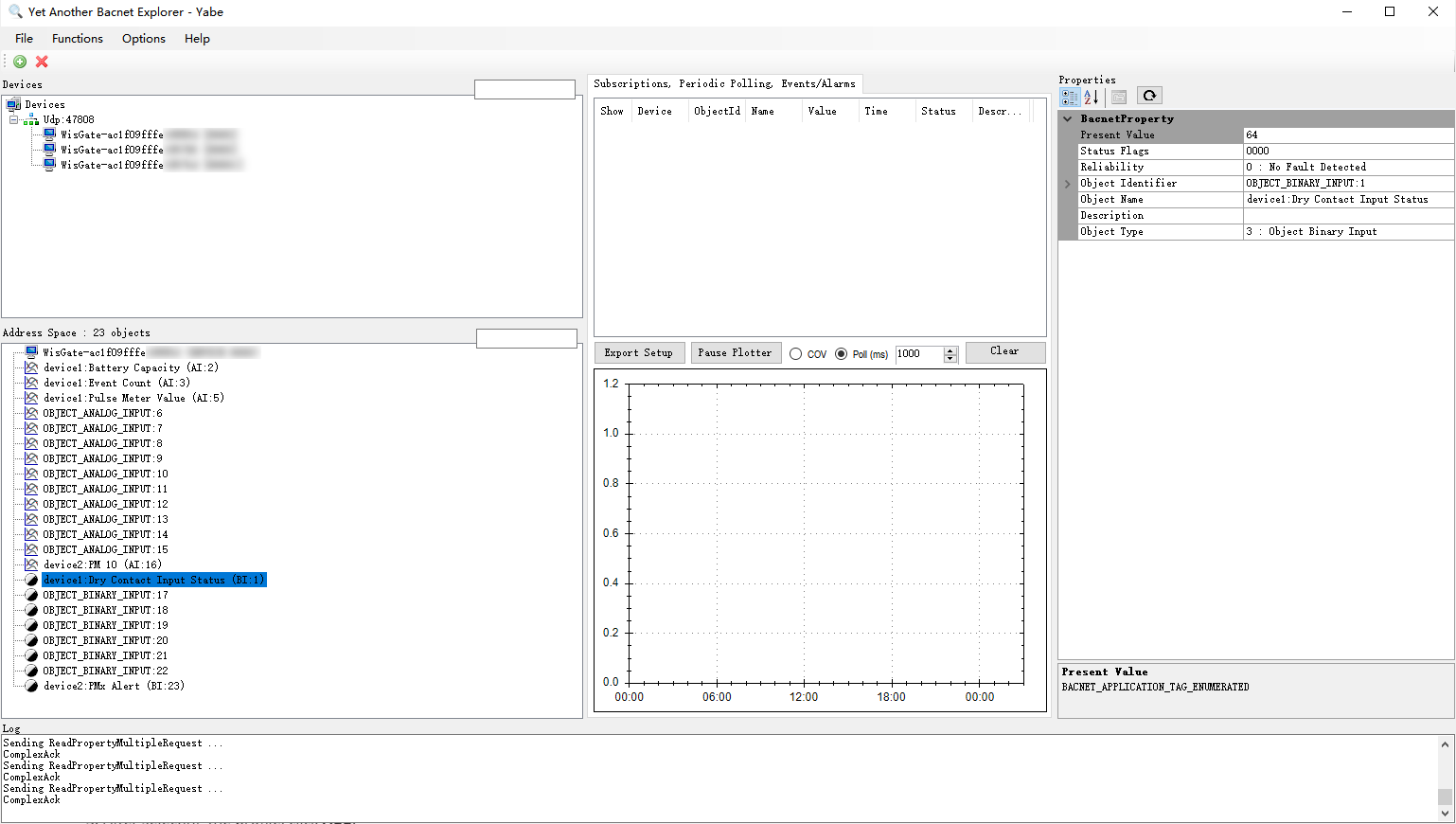 Figure 1: BACnet Objects and Values Displayed in Yabe
In an actual BMS, the displayed object list may vary depending on the BMS software, discovery method, and BACnet network configuration.
After your equipment comes online, you can view its mapped BACnet data either in the Data Points page or inside your Building Management System (BMS).
Manage BACnet Equipment
After adding devices to the BACnet Gateway, you can manage them from the Equipment page in the BACnet Gateway Extension. Equipment management includes organizing, renaming, deleting, and exporting equipment information.
You can also view BACnet-managed Applications and End Devices from LoRa > Applications for status checking and troubleshooting.
BACnet-managed Applications and End Devices under LoRa > Applications are maintained by the BACnet Gateway Extension and cannot be modified directly.
To add equipment, update equipment settings, select profiles, or manage BACnet object mappings, use the BACnet Gateway Extension.
Manage Equipment in the BACnet Gateway
Go to the Equipment tab in the BACnet Gateway Extension to view all devices registered as BACnet equipment.
You can use the search bar to quickly locate equipment by Name or DevEUI. You can also use groups to organize equipment by project, location, floor, room, device type, or maintenance scope.
You can manage a single equipment item or select multiple equipment items for bulk operations.
To manage multiple equipment items, select them using the checkboxes on the left. After selection, bulk action buttons appear at the top of the table.
Reassign Group
You can move equipment to another group. This helps organize devices by location, project, device type, or maintenance scope.
- Select Reassign equipment group from the ⋮ menu for a single equipment item, or select multiple equipment items and click Reassign Group.
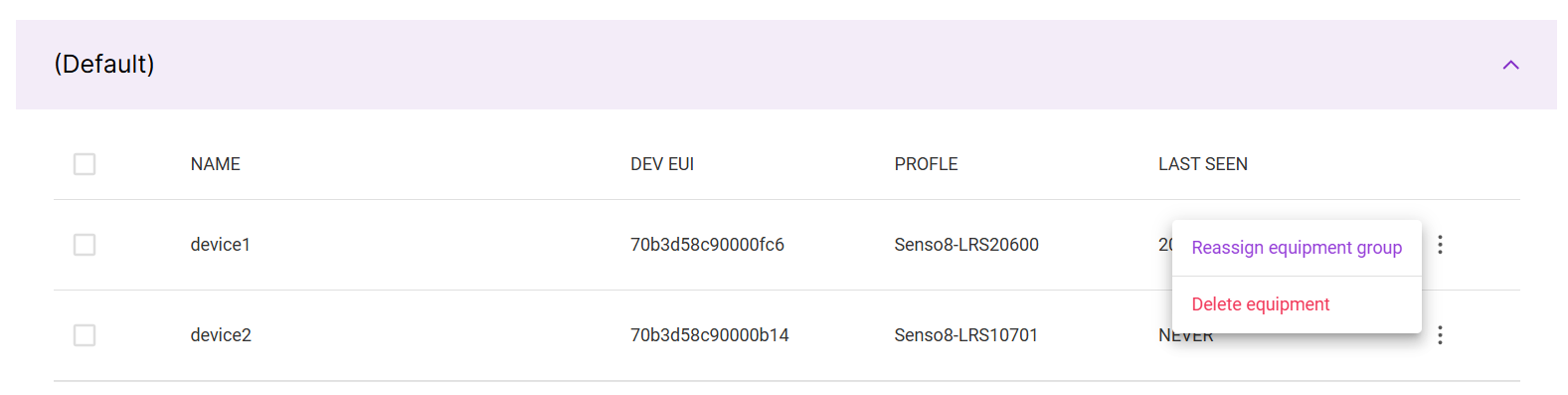 Figure 1: Single Equipment Actions
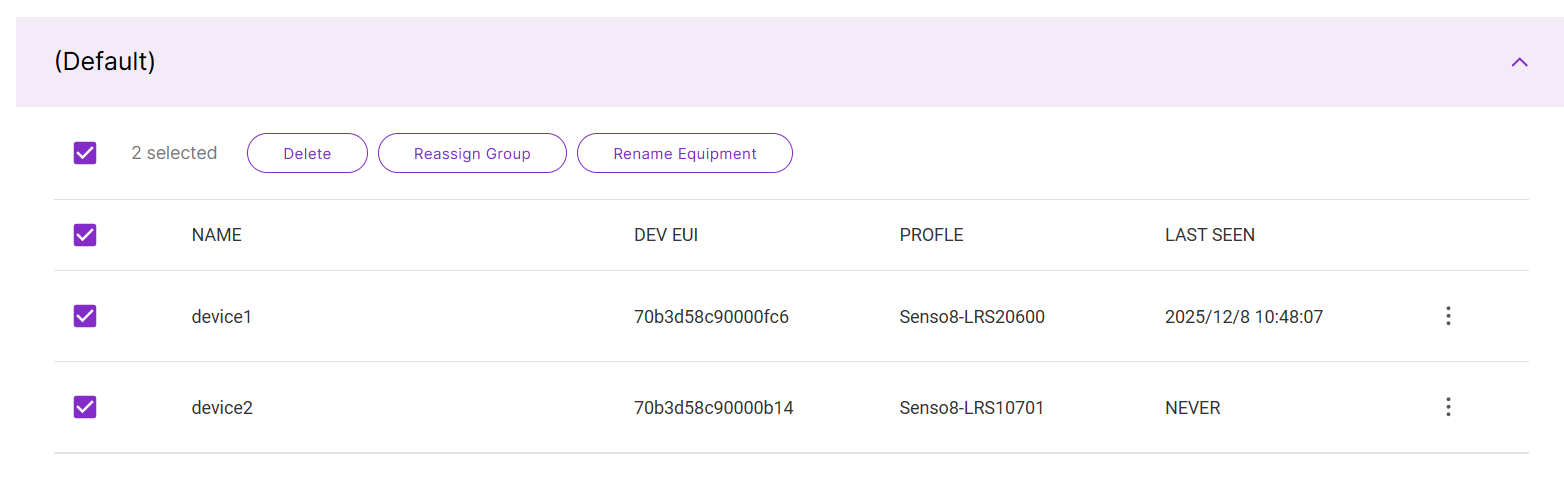 Figure 1: Bulk Equipment Actions
- In the pop-up window, search for and select the target group.
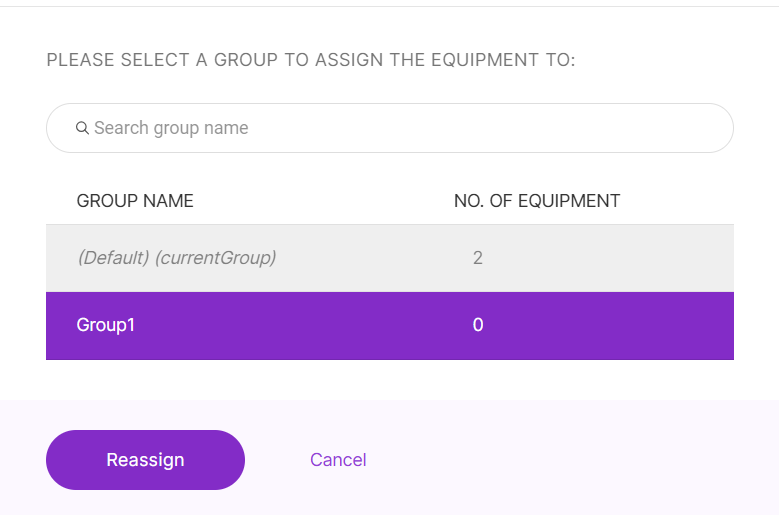 Figure 1: Assign to a New Group
- Click Reassign to complete the action.
Rename Equipment
You can rename equipment to make it easier to identify in the BACnet Gateway, exported CSV files, and BMS point lists.
To rename a single equipment item, click the edit icon in the Name column and enter the new name.
To rename multiple equipment items, select the equipment items, click Rename Equipment, enter the new name, and click Rename.
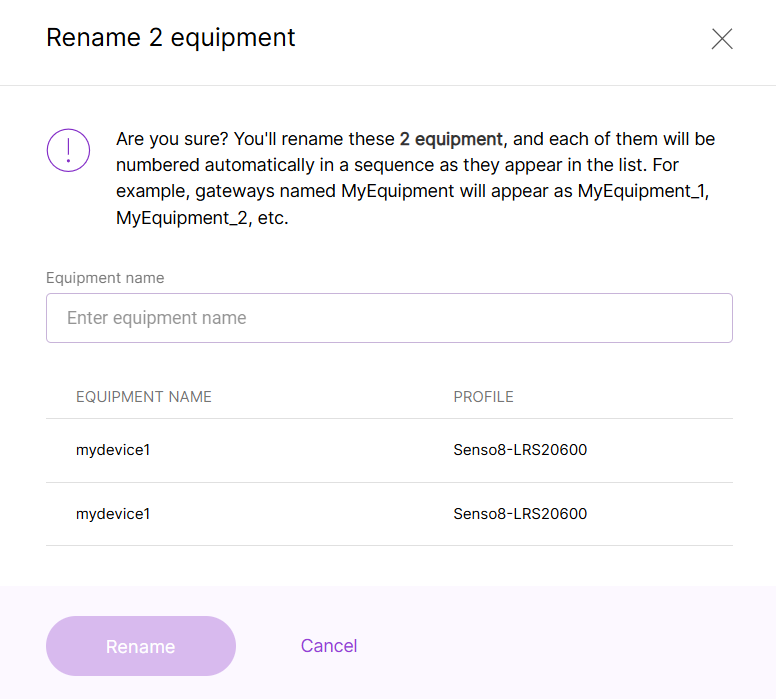 Figure 1: Bulk Rename Equipment
Use clear and consistent equipment names. Equipment names may be used in data point names, exported CSV files, and BMS point identification.
Delete Equipment
You can delete equipment from the BACnet Gateway when it is no longer needed.
Deleting equipment removes it from the BACnet Gateway. This action does not delete the associated equipment profile.
If the equipment needs to be used again, you must add it again.
- Select Delete equipment from the ⋮ menu for a single equipment item, or select multiple equipment items and click Delete.
Figure 1: Single Equipment ActionsFigure 1: Bulk Equipment Actions- Confirm the action in the pop-up window.
Add Group
Click Add Group to create a new equipment group.
Groups help you organize equipment based on project, location, floor, room, device type, or maintenance scope.
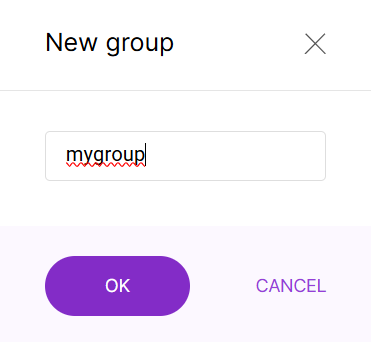 Figure 1: Create a Group
Export Equipment Data
Click Export to download registered equipment information as a CSV file.
The exported CSV can be used for equipment backup, review, or as a reference when replacing devices. It includes device authentication information and BACnet data point mapping information.
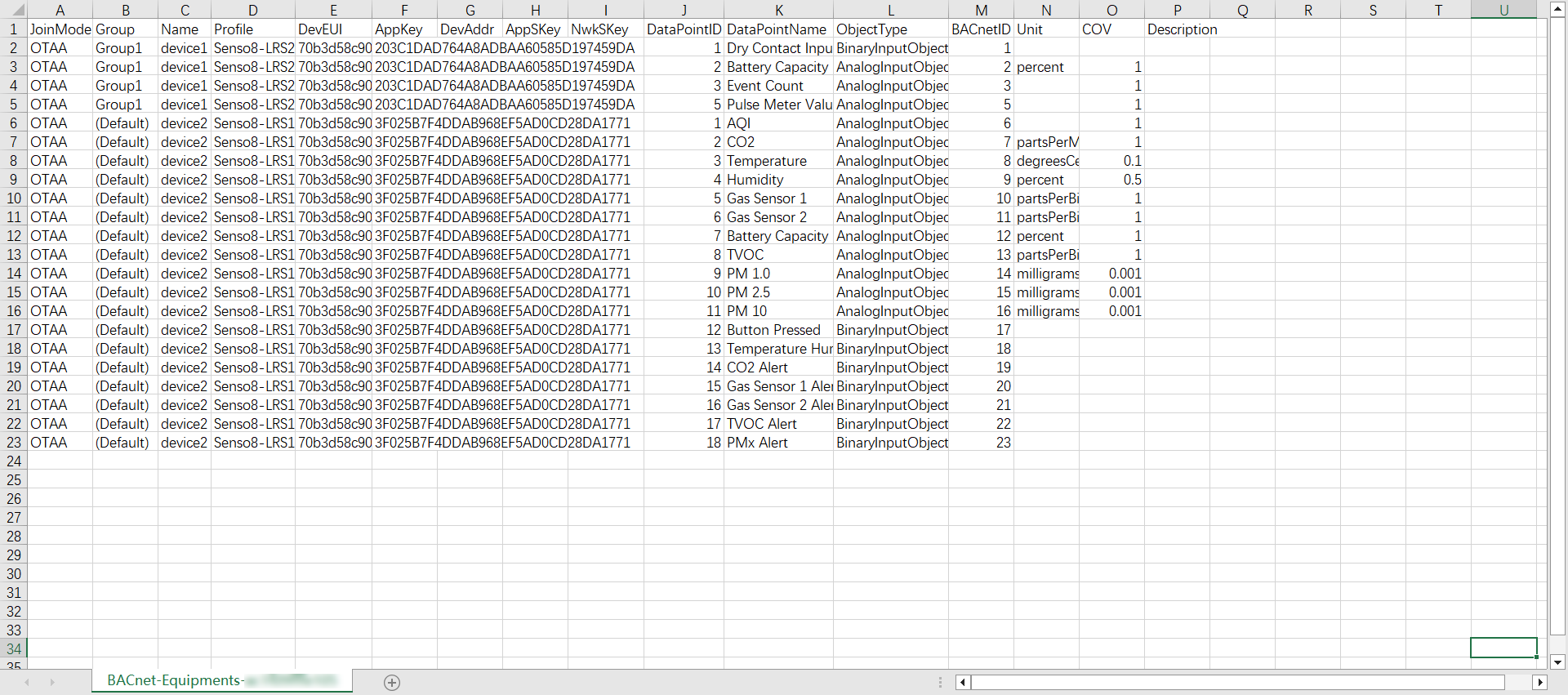 Figure 1: Equipment Data CSV Structure
CSV Field Descriptions
| Field Name | Description |
|---|---|
| JoinMode | LoRaWAN join mode, such as OTAA or ABP. |
| Group | The equipment group assigned to the device. |
| Name | The equipment name. |
| Profile | The equipment profile applied to the device. |
| DevEUI | The unique DevEUI of the LoRaWAN device. |
| APPKey | The application key used in OTAA mode. |
| DevAddr | The device address used in ABP mode. |
| AppSKey | The application session key used in ABP mode. |
| NwkSKey | The network session key used in ABP mode. |
| DataPointID | The internal data point ID defined by the profile or generated by the system. |
| DataPointName | The name of the data point. |
| ObjectType | The BACnet object type mapped to the data point. |
| BACnetID | The BACnet object instance ID. |
| Unit | The unit of the data point. |
| COV | Change-of-Value increment used for BACnet COV reporting. |
| Description | Additional description of the data point. |
When replacing a sensor, you can export the equipment data, update the device authentication information such as DevEUI, AppKey, DevAddr, AppSKey, or NwkSKey, and import the updated file again. This helps keep the BACnet point mapping unchanged, so the BMS configuration does not need to be rebuilt.
View BACnet-managed Devices in LoRa Applications
Equipment added in the BACnet Gateway Extension is also displayed under LoRa > Applications. This allows you to view the corresponding BACnet Application and End Devices created in the built-in Network Server.
Use this page for status checking and troubleshooting only. BACnet-managed Applications and End Devices cannot be modified directly from LoRa > Applications.
View the BACnet Application
Go to LoRa > Applications to view the BACnet Application created by the BACnet Gateway Extension.
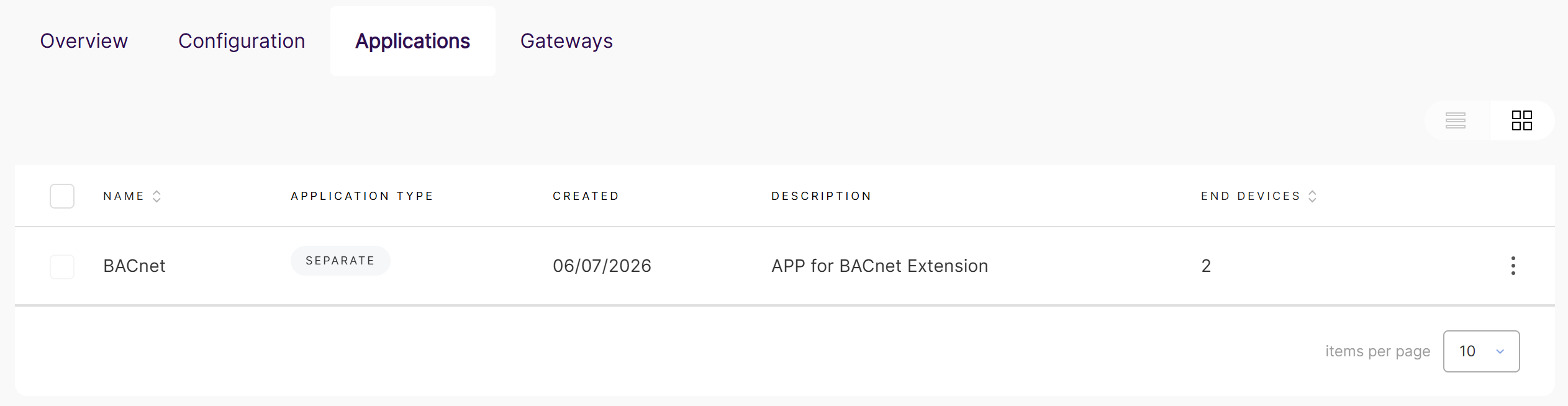 Figure 1: BACnet Application in Built-in NS
The Application list may include the following information:
| Item | Description |
|---|---|
| Name | The Application name created for the BACnet Gateway. |
| Application Type | The Application type used by the built-in NS. |
| Created | The time when the Application was created. |
| Description | The Application description. |
| End Devices | The number of End Devices associated with this Application. |
View BACnet End Devices
Open the BACnet Application and go to the End devices tab to view the End Devices managed by the BACnet Gateway.
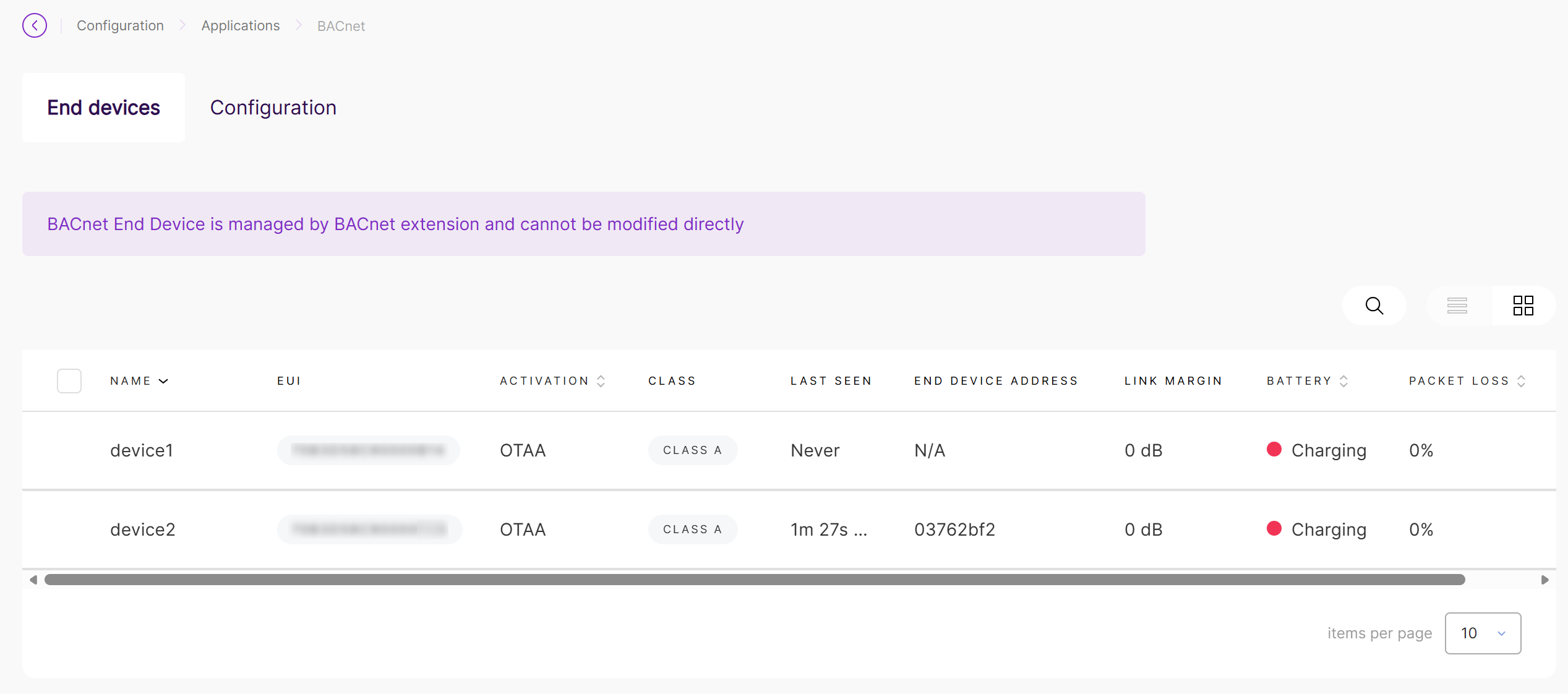 Figure 1: BACnet-managed End Devices
You can use this page to confirm whether BACnet-managed devices have joined the built-in NS and whether recent uplinks have been received.
The End Devices shown here are created and maintained by the BACnet Gateway Extension. Use this page for device status checking only.
View BACnet Application Configuration
Open the BACnet Application and go to the Configuration tab to view the Application settings.
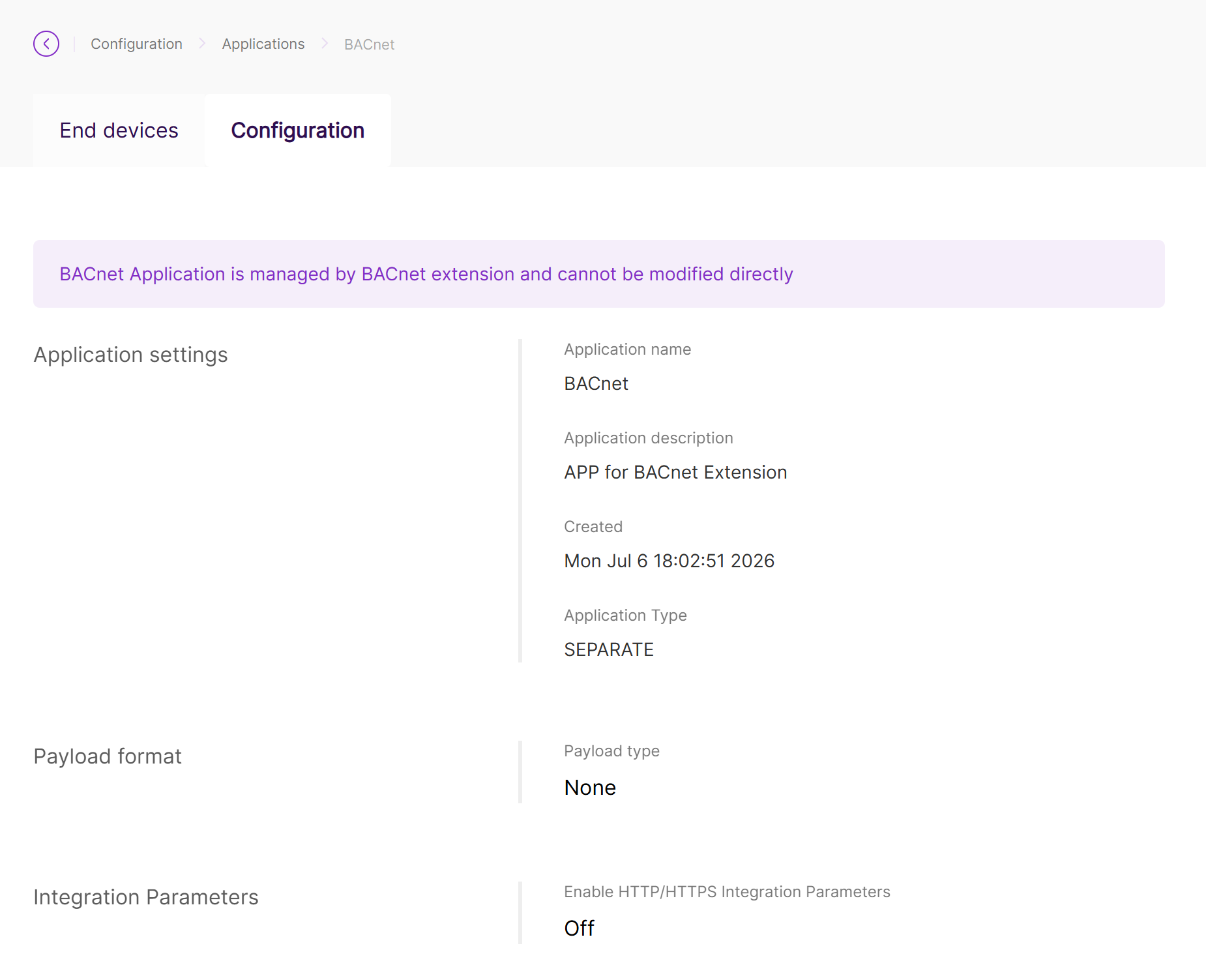 Figure 1: BACnet Application Configuration
View BACnet End Device Details
You can open a BACnet-managed End Device to view additional device information.
The Overview page may show uplink and downlink counters, battery status, DevAddr, packet loss, Last Seen time, SNR/RSSI statistics, traffic history, and data rate statistics.
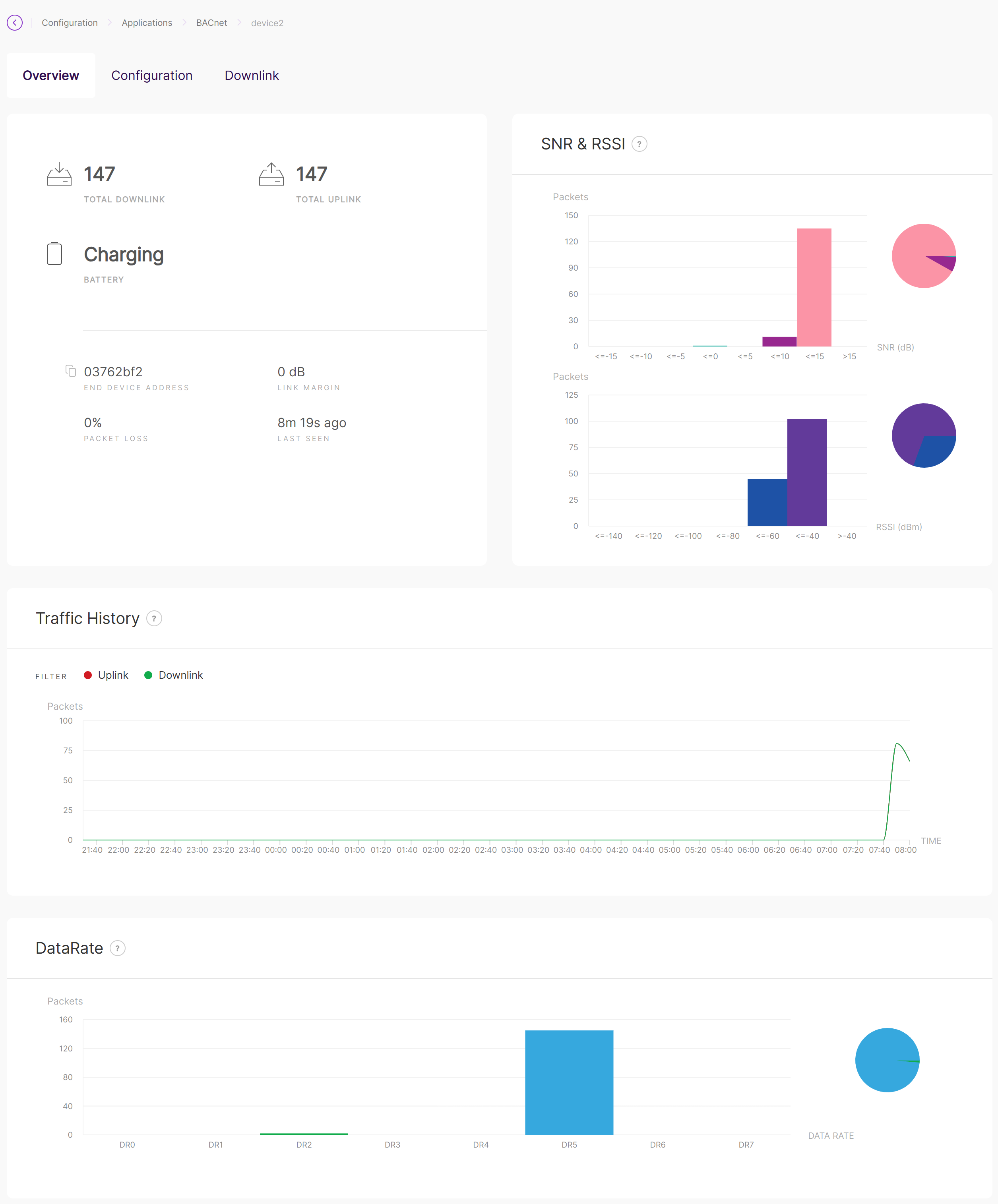 Figure 1: Built-in NS End Device Overview
The Configuration page shows the End Device configuration generated by the BACnet Gateway Extension.
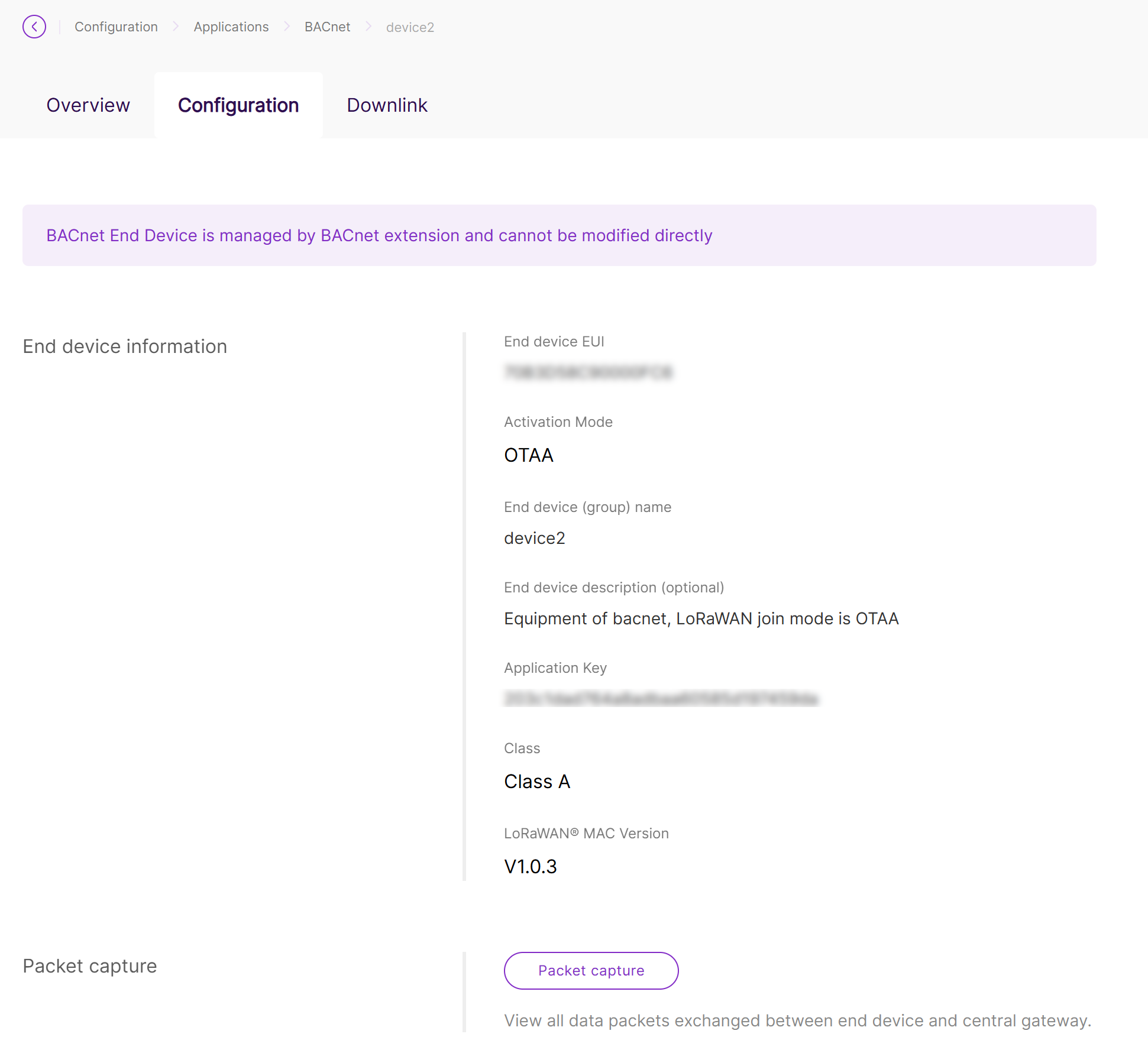 Figure 1: Built-in NS End Device Configuration
View Packet Capture
You can use Packet capture from the End Device details page to inspect packets exchanged between the End Device and the gateway.
This is useful for troubleshooting LoRaWAN communication issues, such as checking whether the device has joined successfully, whether uplinks are received, and whether downlinks are sent.
To access Packet capture:
- Go to LoRa > Applications.
- Open the BACnet Application.
- Select the target End Device.
- Go to the Configuration tab.
- Click Packet capture.
Packet capture is used for LoRaWAN status checking and troubleshooting only.
MQTT Integration
Configure MQTT integration for the BACnet Gateway to publish equipment data or data point information to an MQTT broker.
The BACnet Gateway Extension supports dual services: BACnet/IP Gateway and MQTT. If you need to integrate with third-party MQTT applications, follow the steps below to configure the MQTT settings.
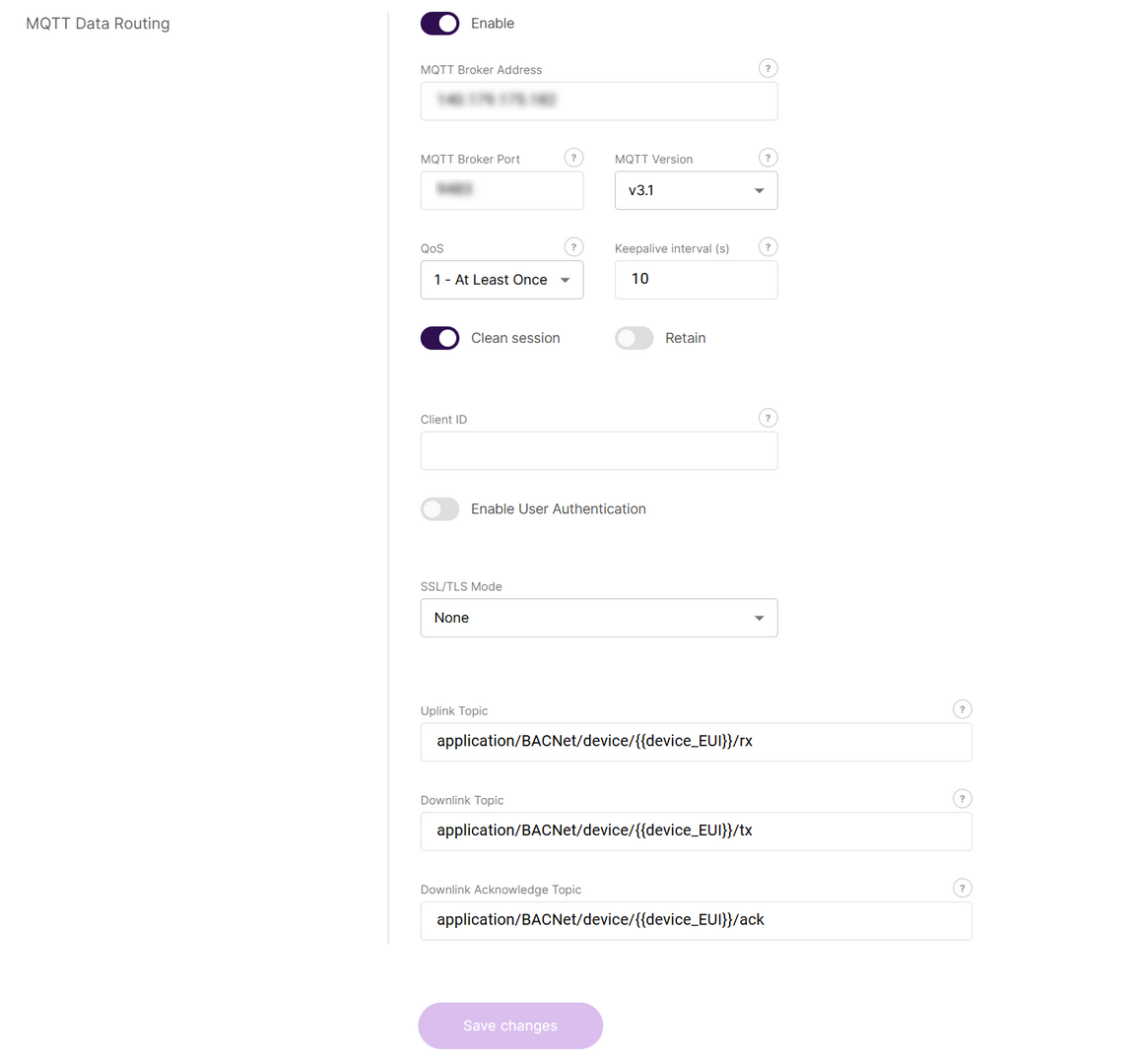 Figure 1: Configure MQTT Integration
- In the MQTT Data Routing section, click the Enable button to activate MQTT integration.
- Configure the MQTT integration parameters:
- MQTT Broker Address: The hostname or IP address of the MQTT server to connect to.
- MQTT Broker Port: The port number for the MQTT server (default: 1883 for unencrypted, 8883 for TLS).
- MQTT Version: Select the MQTT protocol version to match your server.
- QoS: Quality of Service level for message delivery
- 0: At most once
- 1: At least once
- 2: Exactly once
- Keepalive interval (s): Heartbeat interval in seconds to keep the connection alive between client and broker.
- Clean session: If enabled, the broker does not store session data when the client disconnects.
- Retain: If enabled, the broker retains the last message sent to each topic.
- Client ID: Unique identifier for this MQTT client, used to distinguish between multiple clients.
- Enable User Authentication: Requires username/password login to the MQTT broker for enhanced security.
- Username: The username used to authenticate with the MQTT broker.
- Password: The password corresponding to the above username.
- SSL/TLS Mode: Option to enable encrypted communication between client and broker.
- None: No encryption
- CA certificate: The CA root certificate to verify the MQTT broker’s identity.
- Client certificate: The X.509 certificate for client authentication (for mutual TLS).
- Client key: The private key file matching the client certificate.
- Key Pass Phrase (optional): The password for the encrypted private key file.
- TLS Version: Specify the TLS version for securing the connection
- Uplink Topic/Downlink Topic/Downlink Acknowledge Topic: MQTT topics used by the gateway to publish and receive messages to/from the broker.
- Click Save changes.
After MQTT integration is enabled, the BACnet Gateway publishes device uplink data to the configured MQTT broker in JSON format.
Click to view the structure of the published message
{
  "deduplicationId": "89a5c63d-8371-4cb9-93b7-9ba71888b785",
  "time": "2026-01-21T06:41:47.256070904+00:00",
  "deviceInfo": {
    "tenantId": "52f14cd4-c6f1-4fbd-8f87-4025e1d49242",
    "tenantName": "ChirpStack",
    "applicationId": "f07368c1-00cd-4edc-b531-ebd61a273977",
    "applicationName": "BACNet",
    "deviceProfileId": "e392f363-f742-4096-b143-9b71f7869e60",
    "deviceProfileName": "20100",
    "deviceName": "20100",
    "devEui": "70b3d58c9000042b",
    "deviceClassEnabled": "CLASS_A",
    "tags": {
      "payload_type": "NONE",
      "integration_http_enabled": "false"
    }
  },
  "devAddr": "0241e033",
  "adr": true,
  "dr": 5,
  "fCnt": 20,
  "fPort": 10,
  "confirmed": false,
  "data": "ASFkAQABHwAAAAA=",
  "rxInfo": [
    {
      "gatewayId": "ac1f09fffe1057bd",
      "uplinkId": 1878154886,
      "nsTime": "2026-01-21T06:41:47.006301626+00:00",
      "rssi": -103,
      "snr": 8.8,
      "location": {
        "source": "GPS"
      },
      "context": "rM+kgw=="
    }
  ],
  "txInfo": {
    "frequency": 923200000,
    "modulation": {
      "lora": {
        "bandwidth": 125000,
        "spreadingFactor": 7,
        "codeRate": "CR_4_5"
      }
    }
  },
  "regionConfigId": "as923",
  "decodedPayload": [
    {
      "name": "Temperature",
      "channel": 1,
      "value": 25.6,
      "unit": "°C"
    },
    {
      "name": "Humidity",
      "channel": 2,
      "value": 28.7,
      "unit": "%"
    },
    {
      "name": "Battery",
      "channel": 3,
      "value": 100,
      "unit": "%"
    },
    {
      "name": "HumidityLowAlart",
      "channel": 4,
      "value": 0,
      "unit": null
    },
    {
      "name": "HumidityHighAlart",
      "channel": 5,
      "value": 0,
      "unit": null
    },
    {
      "name": "TemperatureLowAlart",
      "channel": 6,
      "value": 0,
      "unit": null
    },
    {
      "name": "TemperatureHighAlart",
      "channel": 7,
      "value": 0,
      "unit": null
    },
    {
      "name": "ButtonPressed",
      "channel": 8,
      "value": 1,
      "unit": null
    }
  ]
Backup and Restore
The Backup and restore page allows you to back up and restore BACnet Gateway Extension data. This is useful before firmware upgrades, system maintenance, configuration migration, or recovery from an unexpected configuration issue.
The backup file includes BACnet Gateway Extension data such as equipment, profiles, data points, and configuration settings.
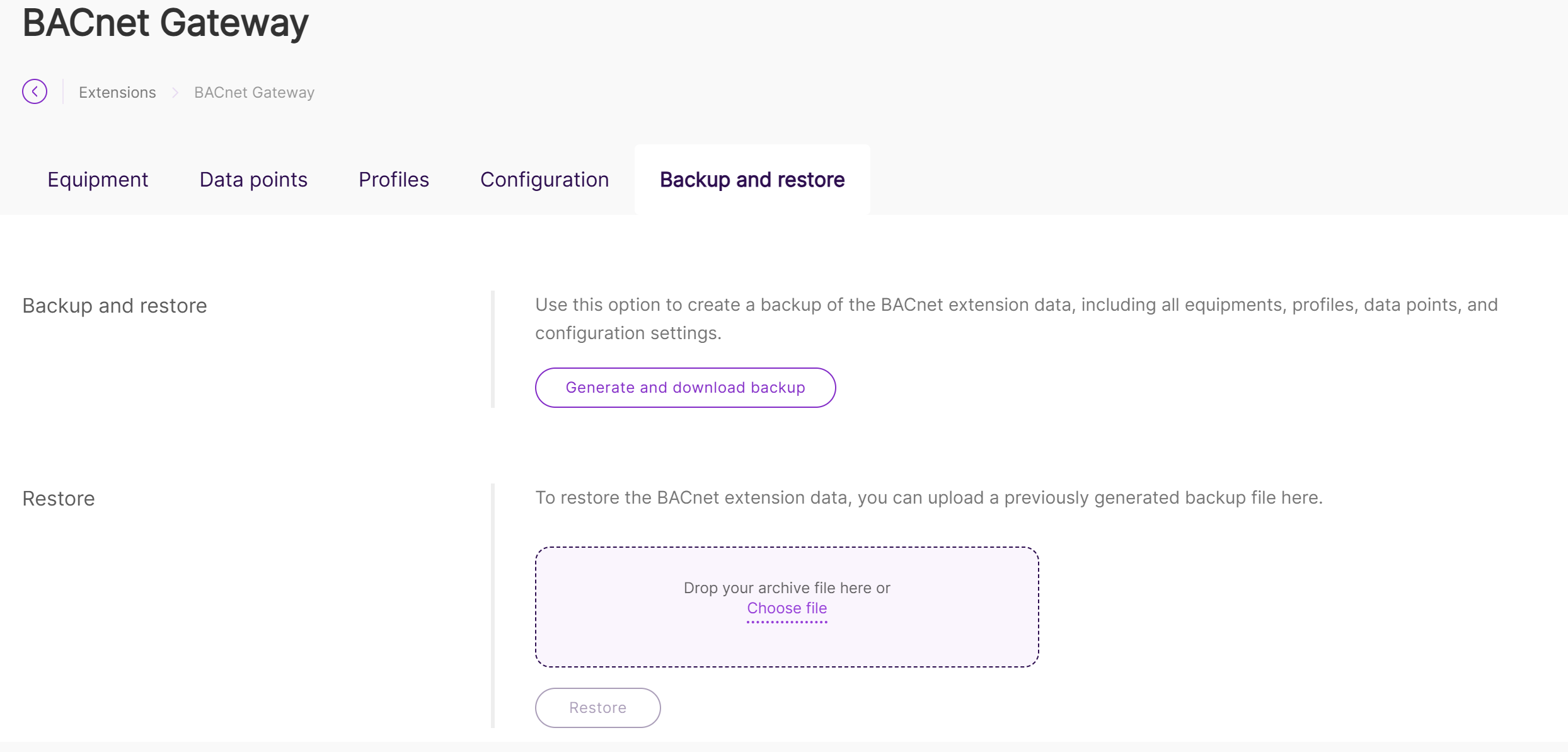 Figure 1: Backup and Restore
The backup file may contain sensitive device and configuration information, such as equipment data, profiles, and device authentication parameters. Store the backup file securely and share it only with authorized personnel.
Create a Backup
To create a backup of the BACnet Gateway Extension data:
- Go to the Backup and restore tab.
- Click Generate and download backup.
- Wait for the system to generate the backup file.
- After the backup is created, the file is downloaded automatically.
The downloaded backup file is an archive file. It contains the BACnet Gateway Extension data required for restore.
Do not manually modify the files inside the backup archive unless instructed by RAK technical support. To restore the BACnet Gateway Extension data, upload the original backup archive file.
Restore from a Backup
You can restore BACnet Gateway Extension data by uploading a previously generated backup file.
To restore a backup:
- Go to the Backup and restore tab.
- In the Restore section, click Choose file, or drag and drop the backup archive file into the upload area.
- After the file is selected, click Restore.
- Wait for the restore process to complete.
Restoring a backup may replace the current BACnet Gateway Extension data, including equipment, profiles, data points, and configuration settings. Before restoring, verify that you have selected the correct backup file.


