Soil pH Monitoring Solution Datasheet
Solution Overview
Description
The Soil pH Solution offers an effective tool for monitoring soil pH levels, comprising the RAK Sensor Hub and Soil pH sensor RK500-22. This comprehensive monitoring system is well-suited for various applications, including agricultural greenhouses, water conservancy, aquaculture, flower cultivation, and pasture grasslands.
With its plug-and-play feature, the Soil pH Solution includes pre-installed components for quick installation and setup. The sensor provides highly accurate soil pH readings, which the Sensor Hub collects and transmits via LoRaWAN or NB-IoT/CAT M1.
The Sensor Hub enables flexible cloud data transmission using the two most common IoT communication protocols. This versatility ensures that data is readily available for storage, visualization, and in-depth analysis, enabling informed decisions based on soil pH levels.
Features
- Supports LoRa and NB-IoT/LTE CAT-M wireless communication modes
- Supports LoRaWAN frequency bands: CN470, EU868, IN865, RU864, US915, AU915, KR920, and AS923-1/2/3/4
- Wide measurement range: 0~14 pH
- Resolution: 0.01 pH
- Easy to install and configure
- Configurable network access with the WisToolBox mobile app
- Low impedance sensitive glass film
- Stable signal
- Good linearity
Specifications
Sensor Hub Specifications
For details, refer to the RAK2560 WisNode Sensor Hub Datasheet.
Sensor Probe IO + Soil pH Sensor Specifications
Sensor Probe IO Datasheet
- For details, refer to the Probe IO Datasheet.
Model RK500-22 Soil pH Sensor Datasheet
| Parameter | Technical Specifications |
|---|---|
| DC Power Supply (default) | 12 VDC |
| Power Consumption | ≤0.2 W |
| pH Test Range | 0~14 pH |
| Stability | ≤0.01 pH/24 hours |
| Output Signal | RS485 output (Modbus protocol) |
| Operating Temperature | 0° C to +80° C |
| Response Time | ≤10 s |
Solar Cell System Datasheet
Definition of Terms
List of Abbreviations| Abbreviation | Definition |
|---|---|
| BMS | Battery Management System |
| BMU | Battery Management Unit |
| BOL | Begin of Life |
| Bus-bar | Battery Pole Connecting Rod |
| CMC | Cell Manager Circuit |
| EOL | End of Life |
| HV | High Voltage |
| LV | Low Voltage |
| OCV | Open Circuit Voltage |
| SOC | Stage of Charge |
| Terminology | Definition |
|---|---|
| Battery Cell | Commonly known as a battery. It is the fundamental unit of energy storage, which converts chemical energy to electrical energy. |
| Battery Module | The intermediate energy storage unit comprises several individual cells, circuitry components, and electrical and communication interfaces. |
| Battery Pack | A comprehensive power system consisting of multiple battery modules and circuits working together to supply power to electrical devices. |
| Rated Voltage | Refers to the approximate voltage value that a battery is designed to operate at or provide. |
| Capacity | The amount of electrical charge that a fully charged battery can store and subsequently provide to a device or system. Unit: Ampere-hours (Ah) |
| Energy Capacity | The total amount of energy that a fully charged battery can deliver under specific conditions. Unit: Watt-hours (Wh) or kilowatt-hours (kWh) |
| Rated Capacity | The minimum capacity that a fully charged battery can deliver at the beginning of its life (BOL), typically measured under specific conditions such as a discharge rate of 1 C (discharge C-rate). |
| Units | V: Volt, voltage A: Ampere, current Ah: Ampere-hour, charge Wh: Watt-hour, electrical energy Ω: Ohm, resistance ° C: degrees Celsius, temperature mm: millimeter, length s: seconds, time kg: kilogram, weight Hz: Hertz, frequency |
Main Specifications
| Parameter | Specifications | Remark |
|---|---|---|
| Battery Model | RAK9154 | |
| Battery Cell Model | Rechargeable cylindrical lithium-ion battery H18650CH | H18650CH or equivalent product |
| Rated Capacity | 5200 mAh | |
| Rated Voltage | 10.8 V | Single battery voltage 3.6 V |
| Operating Voltage Range | 9 V~12.6 V | |
| Rated Power | 56.16 Wh | |
| SOC Transportation Range | 50% | |
| Operating Temperature | Charging temperature: 0° C~45° C Discharge temperature: -20° C~60° C | |
| Storage Temperature | -20° C~60° C | More than three months @ 25° C |
| Operating Humidity | 20~80° %RH | |
| PV Input | 18° V/1.0° A | Typical |
| Maximum PV Input Voltage | 30 V | Open circuit voltage |
| Maximum Continuous Charging Current | 0.2 C (1.0 A) | Limited by solar charger |
| Maximum Continuous Discharging current | 0.4 C (2.0 A) | |
| ∆ Voltage | ≤20 mV | SOC 30 %~60 %; rest for at least 2 hours after charging or discharging |
| Weight | 0.85 kg | |
| Dimension | Length: 180 (±3) mm Width: 130 (±3) mm Height: 60 (±3) mm |
Interfaces
Battery System Structure
As shown in Figure 1, the RAK9154 battery system comprises two sets of three 2600 mAh battery units connected in series. The system also incorporates one (1) BMS board integrated with an 18 V input solar charger.
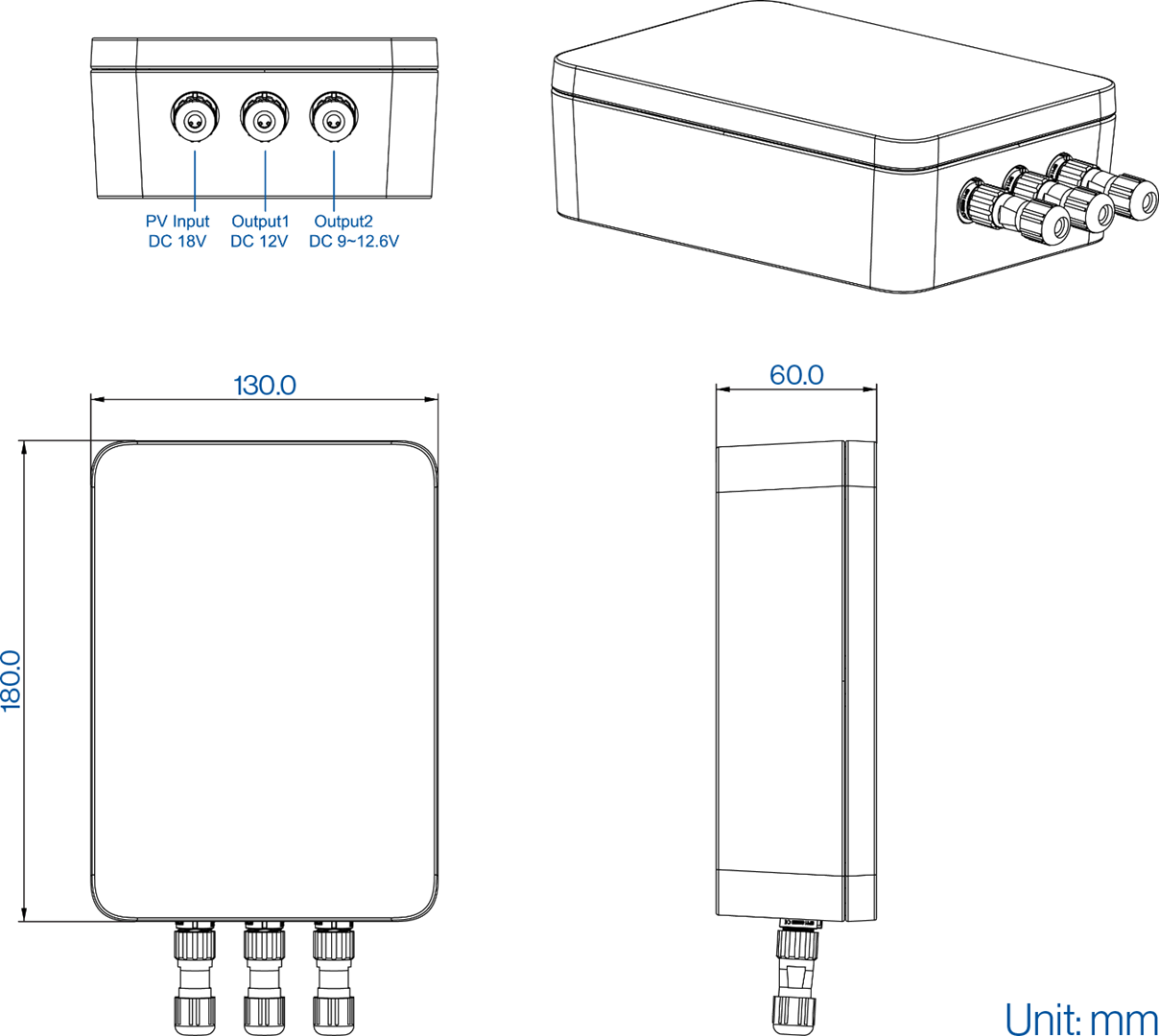 Figure 1: RAK9154 battery system
Electrical Characteristics
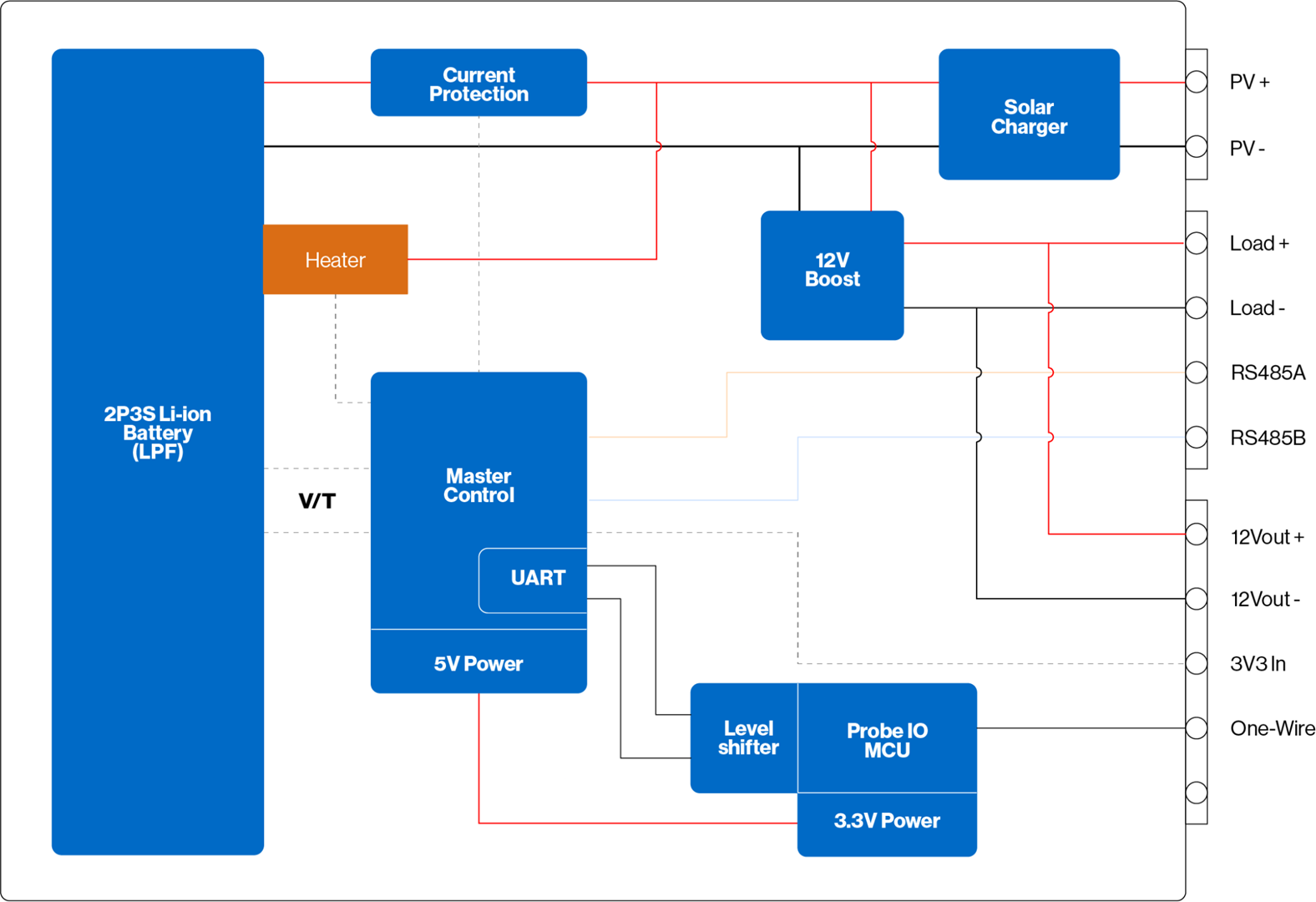 Figure 1: RAK9154 electrical diagram
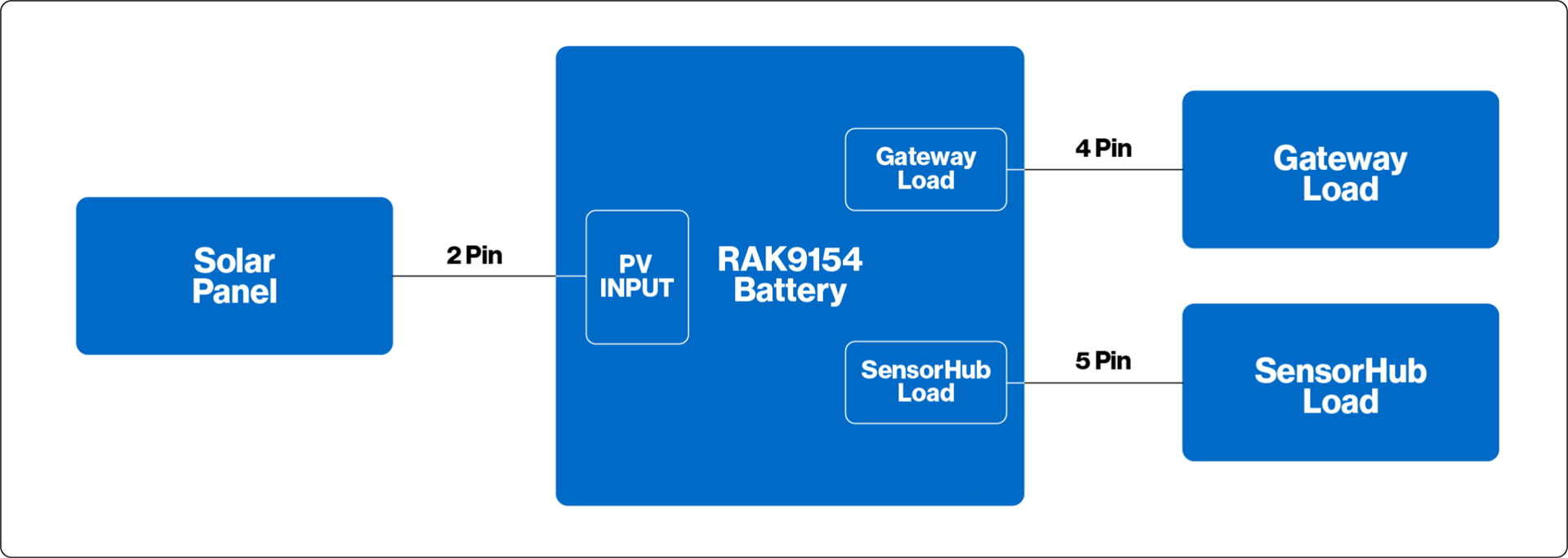 Figure 1: System circuit diagram
| Connector | Connector Socket Model | Connector Plug Model | Definition | Remark |
|---|---|---|---|---|
| Gateway Load | SP1110/P4 | SP1110/P4-N | Pin1: P+ Pin2: P- Pin3: R485A Pin4: RS485B | SP11 IP67 Rated current 2 A Contact diameter 0.75 mm *4 |
| Sensor Hub Load | SP1110/P5 | SP1110/P5-N | Pin1: P+ Pin2: P- Pin3: TXD Pin4: 3V3_In Pin5: RXD | SP11 IP67 Rated current 2 A Contact diameter 0.75 mm *5 |
| PV Input | SP1110/P2 | SP1110/P2-N | Pin1: PV+ Pin2: PV- | SP11 IP67 Rated current 1 A Contact diameter 1.0 mm *2 |
Sensor Characteristics
The following tables show the sensor data definition and the data format of the Soil pH Monitoring Solution.
- Register Summary
| Register Name | Function Code | Register Address | Data Length | Sensor Code | Ratio | Unit | Resolution | Range | Precision |
|---|---|---|---|---|---|---|---|---|---|
| High Precision pH Value | 0x03 | 0x0006 | 2 | 0xC1 | 0.01 | pH | ± 0.01pH | 0~14pH | ± 0.01pH |
| Low Precision pH Value | 0x03 | 0x000d | 2 | 0xC2 | 0.1 | pH | ± 0.01pH | 0~14pH | ± 0.01pH |
- Data Interpretation
| ID (Channel) | Type | Data |
|---|---|---|
| 1 byte | 1 byte | 2 bytes |
With the defined data, here's how to interpret the payload received data:
Data Sample 1:Payload (hex) received data: 01C1 0320
| ID (Channel) | Type | Data |
|---|---|---|
| 01 | C1 | 0320 |
Convert the value to decimal:
- pH:
01C1 - Data:
0320
0320 (hex) = 800 (dec)
800 × 0.01 (conversion factor) = 8 pH
Payload (hex) received data: 01C2 002d
| ID (Channel) | Type | Data |
|---|---|---|
| 01 | C2 | 002d |
Convert the value to decimal:
- pH:
01C2 - Data:
002d
002d (hex) = 45 (dec)
45 × 0.1 (conversion factor) = 4.5 pH
Environmental Requirements
Transportation Requirements
- When transporting the battery, avoid severe vibrations, shaking, and exposure to sunlight or rain.
- Do not invert the battery to prevent potential short circuits.
- During loading and unloading, exercise caution to prevent the battery from falling, rolling, or experiencing heavy pressure.
Storage Requirements
Store the module in a partially charged state, typically around 40 % state of charge (SOC). Ensure the storage environment meets the following requirements:
Temperature and Humidity| Parameter | Value | Remark |
|---|---|---|
| Temperature | -30° C to 50° C, 40% SOC | Storage time < 3 months |
| 0° C to 25° C, 40% SOC | Storage time > 3 months | |
| Humidity | 2%RH to 90%RH | < 85% Recommended |
-
Storage Environment:
- Store the product in a clean, ventilated, and cool environment.
- Avoid direct sunlight, high temperatures, corrosive gases, severe vibration, mechanical shaking, and heavy pressure.
- Keep the product away from heat sources and store it at an altitude below 1500 meters, maintaining atmospheric pressure between 86 kPa and 106 kPa.
-
Maintenance:
- Charge and discharge the device once a month while storing it at room temperature or in a dry and ventilated environment.
- If the device is stored for more than 30 days, adjust the SOC to 40 % after charging.
- If the module is expected to be stored for more than 30 days, adjust the State of Charge (SOC) to 40% after charging is completed.
The operation of the product must adhere to the provided operating instructions. Installation, maintenance, and usage of this product must strictly comply with relevant safety regulations.
- Avoid storing or using the product in high-temperature environments, and keep it away from heat sources. Temperatures outside the safe range can significantly reduce the performance and lifespan of the product, and may even cause serious consequences such as combustion and explosion.
- Do not store or use the product in environments with high static electricity or high electromagnetic radiation. Doing so may damage the electronic components of the battery, leading to safety hazards.
- Avoid exposing the battery to water or immersing it in water. Otherwise, it may result in internal short circuits, loss of function, or abnormal chemical reactions, leading to fire, smoke explosion, and other incidents.
- If you notice any smoking, heating, discoloration, deformation, or any other abnormalities during the use, storage, transportation, and service of the product, contact a professional immediately for assistance.
- Do not discard waste batteries in fires or incinerators. Waste batteries should be recycled by professional institutions or organizations.
- It is strictly prohibited to place heavy objects on the product or stack them on top of each other.
- Although this module is not a high-voltage energy storage device, improper use may lead to serious consequences, such as combustion and explosion.
- The installation and maintenance of the battery system must be handled only by professional technicians. All operations must strictly adhere to relevant safety regulations. Non-professionals are strictly prohibited from installing, maintaining, and misusing the battery system.


